
 Search
 en
en English
 日本語
日本語 русский
 Español
 Deutsch
 中文简体
中文简体Content
- 1 Understanding the Role of a Light Guide Block
- 2 Why Optical Prism Manufacturing Quality Matters
- 3 Product Advantages of the Light Guide Block
- 4 Core Performance Characteristics
- 5 Advanced Manufacturing Processes Behind the Product
- 6 Company Manufacturing Strengths
- 7 Advantages Over Common Competitor Approaches
- 8 Optical Design Considerations for Light Guide Blocks
- 9 Applications in Automotive Interior Optical Systems
- 10 Applications in Semiconductor and Inspection Equipment
- 11 Applications in Laser and Consumer Optical Products
- 12 Quality Control and Inspection Methods
- 13 Process Control from Prototype to Mass Production
- 14 Material Selection for Different Optical Requirements
- 15 Coating Options and Surface Treatments
- 16 Design for Assembly and Reliability
- 17 How Customers Can Specify a Light Guide Block
- 18 Sustainability and Responsible Manufacturing
- 19 Why This Light Guide Block Is a Strong Choice
- 20 Question and Answer Section
- 20.1 What is a light guide block?
- 20.2 How is a light guide block different from a simple glass block?
- 20.3 What are the main advantages of using a light guide block?
- 20.4 Why is surface quality important?
- 20.5 Can the light guide block be customized?
- 20.6 What materials can be used?
- 20.7 Why are coatings used on light guide blocks?
- 20.8 What industries use light guide blocks?
- 20.9 Why is IATF16949 certification relevant?
- 20.10 How should customers request a quotation or technical evaluation?
- 21 Conclusion
- 22 References
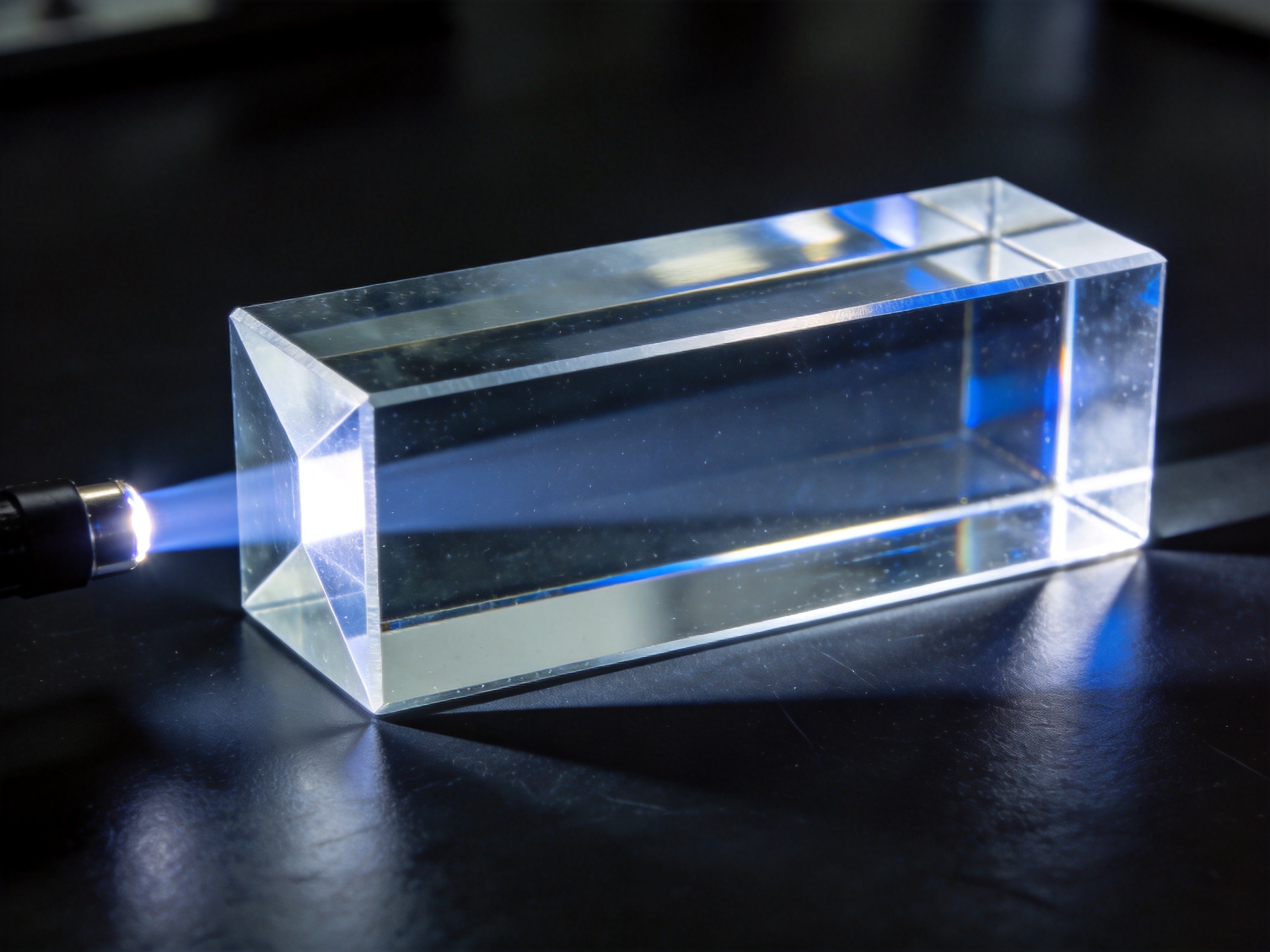
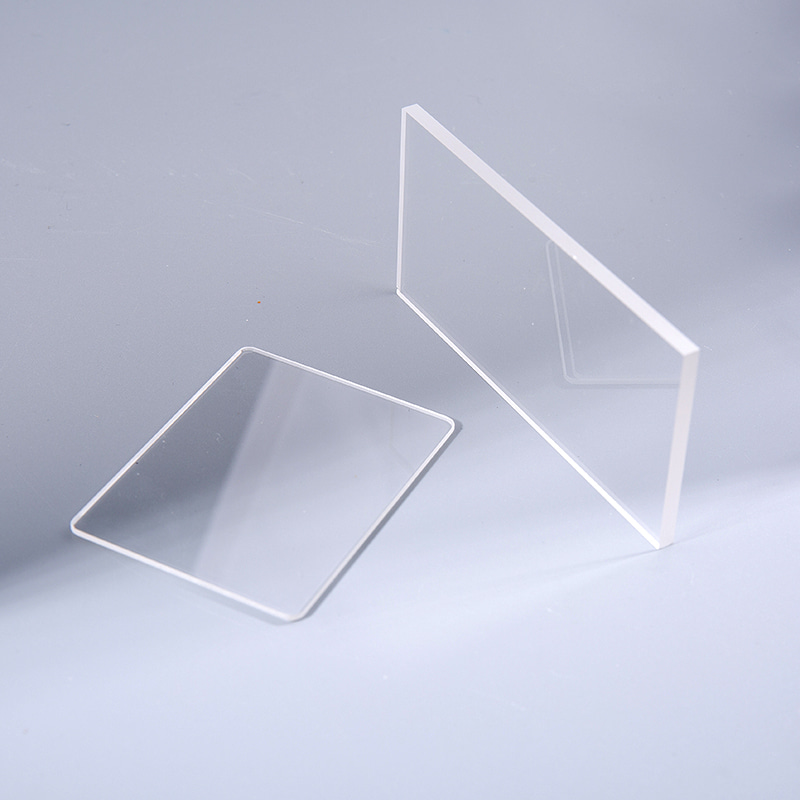
A light guide block is a precision optical prism component designed to collect, redirect, distribute, and condition light inside compact optical systems. In applications where illumination must be uniform, stable, efficient, and mechanically reliable, the light guide block becomes far more than a simple transparent part. It is an engineered optical pathway that helps determine brightness, beam direction, visual comfort, measurement accuracy, and the long-term reliability of the final product.
As an optical prism product, the light guide block combines geometry, material quality, surface accuracy, edge control, coating compatibility, and assembly precision. It may appear visually simple, yet its performance depends on advanced manufacturing processes, strict inspection standards, and deep knowledge of optical behavior. A high-quality light guide block can reduce light loss, improve uniformity, simplify system architecture, and support compact product design. A poorly made component can introduce scattering, ghost images, hot spots, dimensional mismatch, or unstable illumination.
Changzhou Haolilai Photo-Electricity Scientific and Technical Co., Ltd. develops and manufactures precision optical components for demanding fields such as laser optics, automotive optics, semiconductor optics, and consumer optics. With a foundation dating back to 1998, the company combines manufacturing experience, engineering capability, certified quality systems, and large-scale production resources to support customers that require dependable optical components. Its light guide block product reflects this combination of optical design understanding and precision manufacturing control.
Understanding the Role of a Light Guide Block
A light guide block is used to transmit light from one region of a system to another while controlling how that light exits or interacts with other optical elements. Depending on the design, it may guide light by internal reflection, refraction, carefully polished surfaces, angled geometry, or coatings. In many systems, it allows light from an LED, laser, lamp, display module, sensor module, or other source to be directed into a controlled output area.
Because it belongs to the optical prism category, the component often has geometric faces that influence light direction. Unlike a conventional flat window, a light guide block is not merely a protective cover. Its shape and surface quality define optical behavior. Its internal material quality affects transmission. Its edges and angles affect alignment. Its coatings, if applied, affect reflection or transmission at selected wavelengths. Its dimensional consistency affects assembly repeatability.
Light guide blocks are especially valuable in systems where space is limited. Instead of arranging multiple mirrors, holders, air gaps, and alignment mechanisms, engineers can use a precisely manufactured block to perform several optical functions in a stable monolithic form. This reduces mechanical complexity and can improve vibration resistance, assembly speed, and long-term stability.
In illumination systems, the component may help create a uniform field of light. In sensing systems, it may direct illumination to a target area while preventing stray light from reaching a detector. In automotive interiors, it may support ambient lighting, display illumination, indicator lighting, or human-machine interface elements. In semiconductor or inspection equipment, it may guide light into tightly defined regions where precision and repeatability are essential.
Why Optical Prism Manufacturing Quality Matters
Optical prism manufacturing requires a level of precision that ordinary glass processing cannot provide. The difference between a usable prism and a high-performance prism may be measured in micrometers, arc seconds, nanometers of surface roughness, or small variations in coating thickness. These small differences can have large consequences in the final device.
For a light guide block, manufacturing quality affects five major performance categories: optical transmission, beam direction, illumination uniformity, mechanical fit, and durability. Transmission depends on material purity, internal defects, surface polish, and coating design. Beam direction depends on angle accuracy and surface flatness. Uniformity depends on controlled scattering, total internal reflection, and the consistency of geometry. Mechanical fit depends on dimensional tolerance and edge finishing. Durability depends on material selection, stress management, environmental resistance, and process stability.
Competitors that focus only on basic shape production may deliver parts that appear acceptable during simple visual inspection but fail under more demanding optical or environmental tests. For example, small scratches may scatter light and create visible streaks. Slight angle errors may cause beam displacement. Poor edge treatment may create chipping during assembly. Inconsistent polishing may reduce efficiency. Uncontrolled material stress may lead to failure during thermal cycling.
A professional optical component manufacturer must therefore control the complete manufacturing chain. This includes material evaluation, cutting, grinding, fine grinding, polishing, cleaning, coating, cementing when required, final inspection, packaging, and traceability. Changzhou Haolilai Photo-Electricity Scientific and Technical Co., Ltd. has built its reputation around precision optical manufacturing and uses certified quality management systems to ensure that products are not only made, but made repeatedly and reliably.
Product Advantages of the Light Guide Block
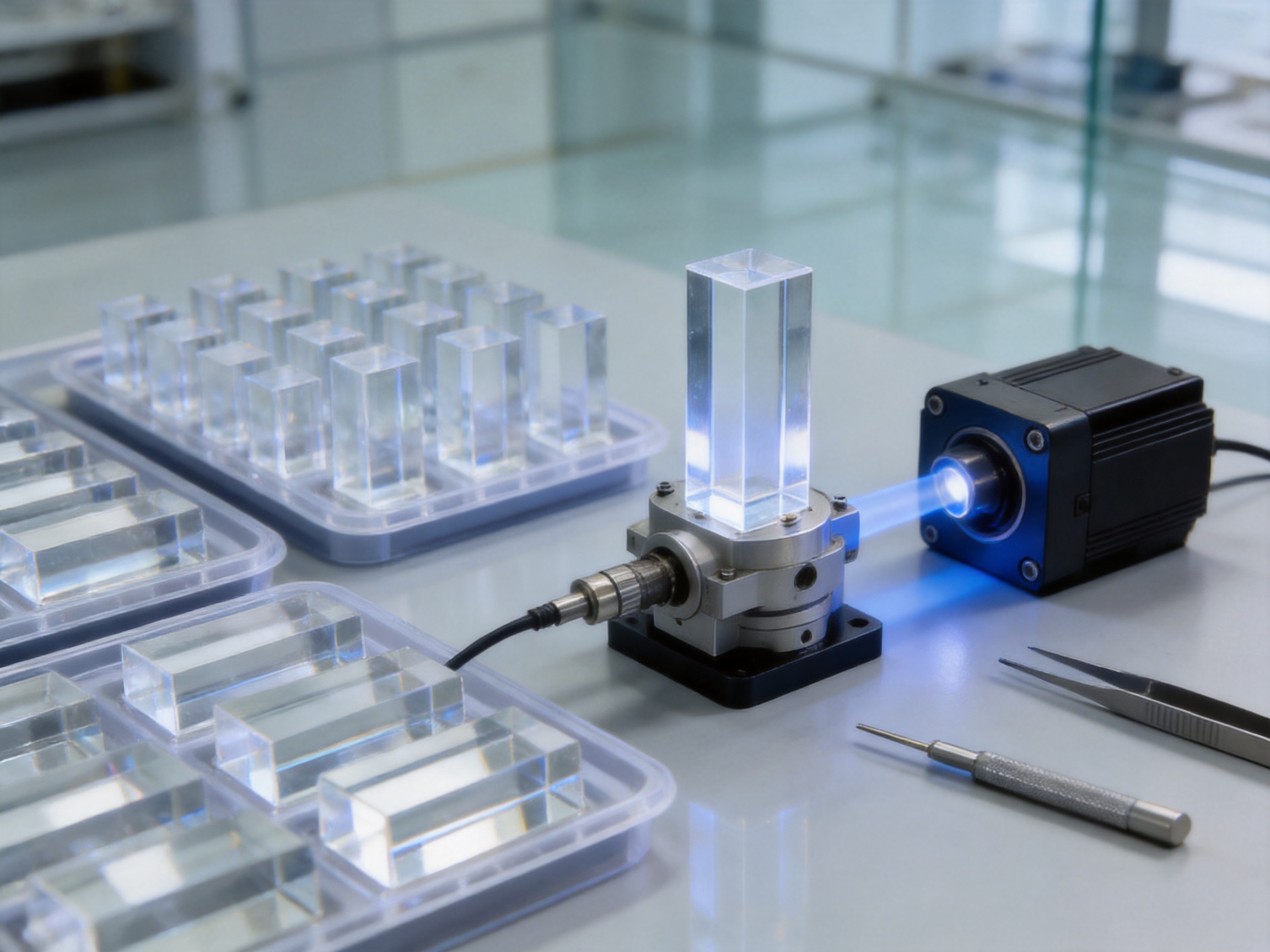
The light guide block offers several advantages compared with conventional optical assemblies and lower-precision alternatives. Its monolithic structure can combine light transmission, beam turning, and distribution functions in one compact element. This can reduce the number of components inside an optical system and minimize the tolerance stack-up that occurs when multiple parts are assembled separately.
One of the most important advantages is improved alignment stability. When an optical pathway is built from separate mirrors, lenses, and mechanical holders, each interface introduces possible misalignment. A light guide block can reduce this problem by integrating the optical pathway within a single controlled geometry. Once the block is manufactured and installed, the relative optical surfaces are fixed by the component itself.
Another advantage is improved design compactness. Modern products, especially automotive interiors, consumer electronics, medical instruments, and semiconductor tools, require smaller and more integrated optical systems. A precisely manufactured light guide block helps engineers design thinner, more efficient, and more robust optical modules. It can be shaped to fit the available space while still guiding light effectively.
High optical efficiency is also a key benefit. By using polished surfaces, high-transmission materials, and accurate geometry, the component can guide light with reduced loss. When coatings are added, efficiency can be further improved at selected wavelengths or incidence angles. This can help reduce power consumption, lower heat generation, and improve the brightness or sensitivity of the final product.
The light guide block can also support excellent illumination uniformity. In many lighting applications, users do not want visible bright spots, dark zones, or harsh edges. By controlling surface finish, geometry, and internal reflection behavior, the block can contribute to smoother light distribution. This is valuable in automotive ambient lighting, display backlighting, instrument panels, optical indicators, and inspection illumination.
In comparison with competitors that produce only standard catalog prism shapes, a manufacturer with strong customization capability can provide geometry, dimensions, materials, coatings, and inspection specifications aligned with the customer’s actual application. This is especially important because light guide blocks are often application-specific. The best component is not always the most complex one, but the one designed and manufactured for the correct optical function, assembly method, and operating environment.
Core Performance Characteristics
A high-quality light guide block should deliver stable performance in several technical areas. These characteristics depend on both design and manufacturing execution. Customers evaluating a supplier should consider not only price but also consistency, documentation, inspection capability, engineering support, and the ability to scale from prototype to production.
| Performance Area | Importance in Application | Manufacturing Factors | Customer Benefit |
|---|---|---|---|
| Optical transmission | Determines how much light reaches the output area | Material quality, polishing, cleaning, coating control | Higher brightness and reduced energy loss |
| Angle accuracy | Controls beam direction and optical alignment | Precision grinding, metrology, process stability | Reliable assembly and predictable optical output |
| Surface quality | Reduces scattering, ghosting, and visual defects | Fine polishing, scratch and dig inspection, clean handling | Clearer light path and improved system appearance |
| Dimensional tolerance | Ensures fit with housings, holders, and modules | Controlled cutting, grinding, edge finishing, final measurement | Faster assembly and lower rejection rates |
| Environmental stability | Supports long-term operation under heat, humidity, and vibration | Material selection, coating durability, stress control | Better reliability in demanding applications |
| Batch consistency | Maintains the same optical result across production lots | Quality systems, traceability, standardized processes | Stable mass production and easier system calibration |
Advanced Manufacturing Processes Behind the Product
The performance of a light guide block begins with material selection. Optical glass, fused silica, borosilicate glass, or other transparent materials may be selected depending on wavelength range, thermal stability, mechanical strength, cost target, and application environment. Material must be free from unacceptable inclusions, bubbles, striae, or internal defects that would interfere with light transmission.
After material confirmation, rough cutting creates the initial blank. Cutting precision matters because it affects material utilization and the amount of grinding needed later. Excessive stress or chipping during cutting can cause hidden defects, so controlled cutting methods and careful handling are essential. The blank is then shaped through grinding to approach the required dimensions and angles.
Fine grinding brings the part closer to optical tolerances. This stage helps control flatness, parallelism, and angular relationships. In a light guide block, even slight angle deviation can shift the output beam or disturb uniformity. Therefore, grinding must be supported by accurate fixtures, stable machines, and experienced operators. The process must also control subsurface damage, because hidden micro-cracks can reduce strength and polishing efficiency.
Polishing is one of the most important stages. Optical polishing converts the ground surfaces into smooth, low-scatter optical faces. Polishing parameters must be adjusted for the material and surface geometry. Pressure, pad condition, slurry composition, time, temperature, and cleaning between steps all influence the final surface. A well-polished surface supports high transmission and predictable reflection. A poorly polished surface can create haze, scattering, and inconsistent illumination.
For some designs, selected surfaces may require special treatment. A surface may be polished to high clarity for transmission, left with controlled texture for diffusion, coated for reflection, or coated for anti-reflection. Some light guide blocks require reflective coatings on specific faces to redirect light, while others rely primarily on total internal reflection. Coating design must account for wavelength, incidence angle, adhesion, environmental durability, and compatibility with assembly processes.
Cleaning is not a simple cosmetic step. Dust, residue, polishing compound, water marks, or fingerprints can reduce optical performance and interfere with coatings or bonding. Precision optical cleaning requires controlled procedures, appropriate solvents or cleaning systems, and clean handling. The finished component must be packaged in a way that protects surfaces from scratches and contamination during shipping and storage.

Company Manufacturing Strengths
Changzhou Haolilai Photo-Electricity Scientific and Technical Co., Ltd. was founded in 1998 and has developed into a professional manufacturer of precision optical components. Located in the national-level High-tech Development District of Changzhou, Jiangsu, China, the company operates from a site covering approximately 35,000 square meters. This scale supports both engineering development and stable production capacity.
The company has obtained ISO9001:2015, ISO14001:2015, and IATF16949 certifications. These certifications are important for customers in industries where repeatability, environmental management, and automotive-grade quality control matter. ISO9001:2015 supports quality management discipline. ISO14001:2015 reflects environmental management responsibility. IATF16949 is especially relevant for automotive supply chains, where process control, traceability, risk management, and continuous improvement are essential.
As a High-Tech enterprise in Jiangsu Province, the company has built technical resources that go beyond basic manufacturing. It has established the Jiangsu Precision Optical Lens Engineering Technology Center and the Jiangsu Enterprise Technology Research Center. These platforms support product development, process optimization, technical problem solving, and cooperation with customers that require customized optical solutions.
The company has obtained multiple invention patents, utility model patents, and Jiangsu High and New Tech Products. Intellectual property achievements indicate a culture of engineering improvement. For customers, this means the supplier is not limited to copying standard shapes, but can support design improvement, manufacturability analysis, and process innovation.
With more than 300 employees and exports to over 20 countries, the company has experience serving international markets. This matters because global customers often require clear specifications, inspection reports, stable packaging, communication discipline, and reliable delivery. The company’s experience in laser optics, automotive optics, semiconductor optics, and consumer optics also helps it understand different application priorities. A laser application may prioritize wavefront quality and coating performance. An automotive application may prioritize durability and mass-production consistency. A semiconductor application may prioritize cleanliness and precision. A consumer application may prioritize compactness, appearance, and cost efficiency.
Advantages Over Common Competitor Approaches
In the optical component market, some suppliers compete mainly on low price. While price is important, optical prism products such as light guide blocks must be evaluated by total value. A low-cost part that causes assembly failures, inconsistent brightness, rework, or field complaints can become more expensive than a precision-manufactured part. The stronger approach is to combine competitive manufacturing with reliable process control.
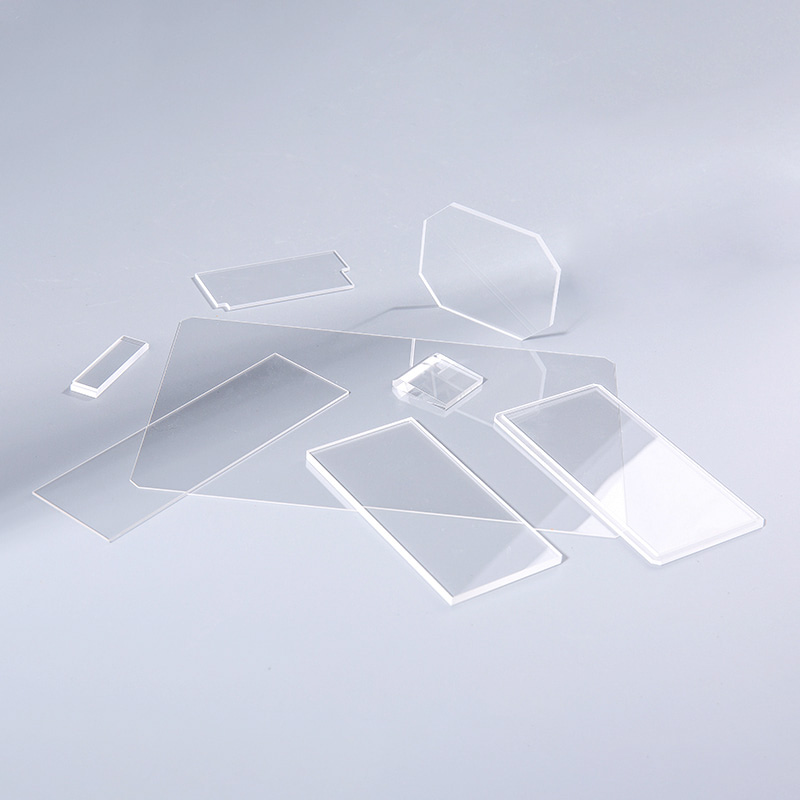
One advantage of this light guide block offering is the company’s ability to support precision customization. Many competitors provide only standard prism sizes or simple rectangular blocks. However, modern optical systems frequently require custom dimensions, non-standard angles, special chamfers, selected coatings, controlled surface quality, and inspection documentation. A manufacturer with engineering resources can help customers define realistic tolerances and avoid unnecessary cost while still achieving the optical target.
Another advantage is experience across multiple optical industries. A supplier that serves only one narrow field may not understand requirements from automotive, semiconductor, laser, and consumer applications. Cross-industry experience allows a manufacturer to apply proven methods from one field to another. For example, automotive quality discipline can improve production consistency for consumer optics. Semiconductor cleanliness expectations can improve handling standards for precision prisms. Laser coating knowledge can support high-efficiency light guide designs.
The company’s certified quality systems provide another competitive advantage. For light guide blocks used in production devices, customers need stable batch-to-batch performance. Quality systems help ensure process documentation, traceability, nonconforming product control, supplier control, corrective action, and continuous improvement. These are not abstract administrative concepts. They directly affect whether every shipment meets the same optical and mechanical requirements.
Manufacturing scale is also important. A small workshop may produce a few acceptable samples but struggle with consistent volume production. A larger professional facility with trained staff, inspection capability, and process discipline is better positioned to move from prototype to mass production. The company’s 35,000-square-meter site and experienced workforce support this transition.
Finally, the company’s technical centers and patent activity indicate a commitment to long-term optical manufacturing development. For customers, this can mean better support when a design faces unexpected issues such as stray light, assembly tolerance conflict, coating durability concerns, or production yield challenges.
Optical Design Considerations for Light Guide Blocks
Designing a successful light guide block begins with understanding the source of light. An LED has different emission characteristics from a laser diode. A display backlight source differs from a collimated beam. A sensor illumination module may need a defined output angle and limited stray light. The block geometry should be selected based on the source size, divergence, wavelength, intensity, thermal behavior, and desired output pattern.
The refractive index of the material is another key factor. It determines how light bends at entry and exit surfaces and whether total internal reflection can occur at certain interfaces. Material selection also affects transmission at different wavelengths. For visible light, many optical glasses provide good performance. For ultraviolet or infrared applications, specialized materials may be necessary.
Surface finish must be matched to the function of each face. Some faces should be highly polished for low loss. Some may require reflective coating. Some may need controlled diffusion to improve uniformity. Some may be hidden mounting faces where optical polish is unnecessary. Correctly specifying each surface can improve performance and control cost.
Chamfers and edge treatments are also part of optical design. Sharp glass edges are fragile and can chip during handling or assembly. However, oversized chamfers may reduce active aperture or alter stray light behavior. A well-designed light guide block balances mechanical robustness with optical aperture needs. Edge blackening or special masking may be considered in some applications to suppress unwanted reflections.
Assembly conditions must be considered early. Will the block be mounted by mechanical clamping, adhesive bonding, optical cement, or integration into a molded housing? Will it experience vibration, thermal cycling, humidity, or cleaning chemicals? The answers influence tolerance selection, coating durability, surface protection, and packaging requirements.
Applications in Automotive Interior Optical Systems
Automotive interiors increasingly use light as a design, safety, and user-interface element. Ambient lighting, illuminated icons, control panels, instrument displays, center consoles, door trim, heads-up interface elements, and sensor illumination modules all require controlled optical components. A light guide block can help direct light precisely within confined interior spaces.
Automotive applications demand more than attractive appearance. Components must withstand temperature variation, vibration, humidity, chemical exposure, and long service life requirements. The relevance of IATF16949 certification becomes clear in this context. Automotive customers require process control, risk analysis, change management, defect prevention, and documented consistency. A light guide block used in a vehicle interior must not only look correct during initial inspection; it must continue performing reliably over years of use.
Uniformity is especially important in automotive lighting. Bright spots or uneven illumination can reduce perceived quality. If a light guide block is part of a visible lighting system, surface defects may become noticeable to the end user. If it is part of a sensing or display system, optical inconsistency can affect functionality. Precision polishing and controlled geometry help reduce these risks.
Compactness is another automotive advantage. Interior designs are space-constrained, and optical paths often must fit around mechanical structures. A custom light guide block can help redirect light through tight spaces without adding bulky assemblies. This supports both styling freedom and functional integration.
Applications in Semiconductor and Inspection Equipment
Semiconductor manufacturing and inspection equipment require optical components with high precision, cleanliness, and repeatability. A light guide block may be used in illumination paths, alignment modules, inspection systems, metrology tools, or compact optical assemblies. In such applications, small optical errors can affect measurement accuracy or image quality.
Cleanliness is critical. Particles or residues on optical surfaces can scatter light or contaminate sensitive environments. Precision cleaning and protective packaging help preserve component quality. Material selection may also need to consider thermal stability and low outgassing requirements depending on the system environment.
Repeatability is equally important. Semiconductor tools often rely on calibrated optical pathways. If replacement parts or production batches vary, system calibration becomes more difficult. Tight dimensional control and optical inspection help ensure that each light guide block behaves predictably.
Advanced inspection equipment may also require control of stray light. Unwanted reflections inside a block can reduce contrast or create measurement artifacts. Proper geometry, coatings, surface finish, and edge treatments can reduce these issues. A manufacturer with experience in precision optics can work with customers to identify and solve such problems.
Applications in Laser and Consumer Optical Products
In laser-related systems, a light guide block may be used to redirect or condition a beam. Laser applications can be demanding because high coherence makes stray reflections, ghost beams, and surface defects more visible. Coating quality and surface flatness may become critical. If power levels are high, coating damage threshold and material absorption must also be considered.
For consumer optics, the priorities may include compact size, attractive appearance, reliable mass production, and cost-effective performance. Light guide blocks may appear in projection devices, display systems, smart hardware, home electronics, optical indicators, and imaging accessories. In these products, users may not know the component exists, but they notice the result: brightness, clarity, uniformity, and product reliability.
The ability to serve both high-precision and volume-sensitive applications is valuable. Customers may need prototypes for early design verification, then thousands or millions of parts as the product matures. A manufacturer that understands both engineering development and production discipline can reduce the risk of transition from sample to mass production.

Quality Control and Inspection Methods
Quality control for a light guide block must include both mechanical and optical inspection. Mechanical inspection confirms dimensions, angles, chamfers, thickness, parallelism, and fit-related characteristics. Optical inspection evaluates surface quality, transmission, coating appearance, defects, and sometimes beam behavior. The exact inspection plan depends on the customer’s specification and application requirements.
Surface quality is often inspected according to scratch and dig standards or customer-specific criteria. Scratches, pits, digs, edge chips, stains, and coating defects can affect both performance and appearance. A controlled inspection process helps ensure that visible and functional defects are identified before shipment.
Angle measurement is essential for prism components. If the angles are outside tolerance, light may exit in the wrong direction. This can cause alignment issues, reduce brightness at the target, or create stray light. Precision angle measurement helps maintain optical consistency.
Flatness and surface form may also be important, particularly when the component interfaces with collimated beams or imaging optics. Surface irregularity can distort wavefronts, affect beam quality, or reduce uniformity. Depending on the requirement, interferometric inspection or other optical metrology methods may be used.
Coating inspection may include visual examination, spectral measurement, adhesion testing, environmental testing, or durability evaluation. Coatings must do more than meet initial reflectance or transmittance values. They must remain stable during handling, assembly, and operation.
Traceability supports continuous improvement. When production records connect materials, process batches, inspection results, and shipments, the manufacturer can analyze problems more effectively and maintain customer confidence. This is especially important for automotive and industrial customers.
Process Control from Prototype to Mass Production
Many optical projects begin with a prototype. At the prototype stage, the main goal is to verify optical function, mechanical fit, and basic manufacturability. However, successful prototype production does not automatically guarantee mass-production success. The process must be designed so that tolerances, yield, cycle time, inspection methods, and cost targets can be sustained at scale.
A strong optical component manufacturer helps customers identify which specifications are critical and which may be optimized. Overly tight tolerances can increase cost without improving system performance. Tolerances that are too loose may cause assembly problems or optical variation. Engineering communication is therefore essential.
During process development, fixtures, grinding parameters, polishing methods, cleaning procedures, and inspection plans are refined. If coatings are required, coating masks, fixtures, process recipes, and test methods are developed. Packaging must also be considered, because precision optical surfaces can be damaged after production if packaging is inadequate.
When production volume increases, consistency becomes the main challenge. Operators must follow standardized procedures. Equipment must be maintained. Measurement systems must be reliable. Nonconforming products must be controlled. Corrective actions must address root causes, not only symptoms. Certified management systems help support this discipline.
For customers, this means lower project risk. A light guide block supplier with mature production control can help shorten development cycles, reduce unexpected delays, and maintain stable delivery quality.
Material Selection for Different Optical Requirements
The choice of material has a direct effect on light guide block performance. Optical glass is commonly used because it offers good transparency, dimensional stability, and polishability. Different glass types provide different refractive indices, dispersion characteristics, thermal expansion values, and transmission ranges. The correct choice depends on the application.
For visible illumination, high-transmission optical glass may provide an excellent balance of performance and cost. For ultraviolet applications, fused silica may be required because many standard glasses absorb ultraviolet light. For infrared applications, specialized materials may be needed depending on wavelength. For automotive interior lighting, material durability and environmental stability are particularly important.
Material stress must also be considered. Internal stress can affect optical behavior and mechanical reliability. Stress may originate from raw material, cutting, grinding, thermal processing, or assembly. Professional optical manufacturing controls process conditions to minimize harmful stress.
Thermal expansion is important when the light guide block is assembled with metals, plastics, adhesives, or other optical components. If materials expand at different rates during temperature cycling, stress can develop. This may affect alignment, coating stability, or even cause cracking. Early consideration of operating temperature range helps avoid later problems.
Chemical durability may also matter. Some components are exposed to cleaning agents, humidity, adhesives, or environmental contaminants. Material and coating selection should consider these conditions. A supplier with experience across multiple industries can recommend practical choices based on performance and manufacturability.
Coating Options and Surface Treatments
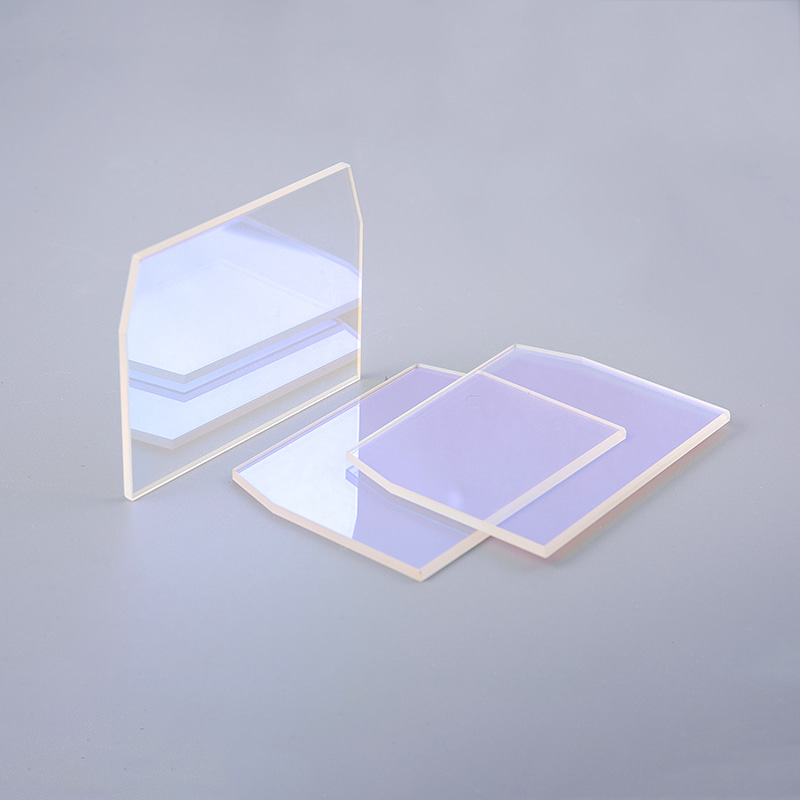
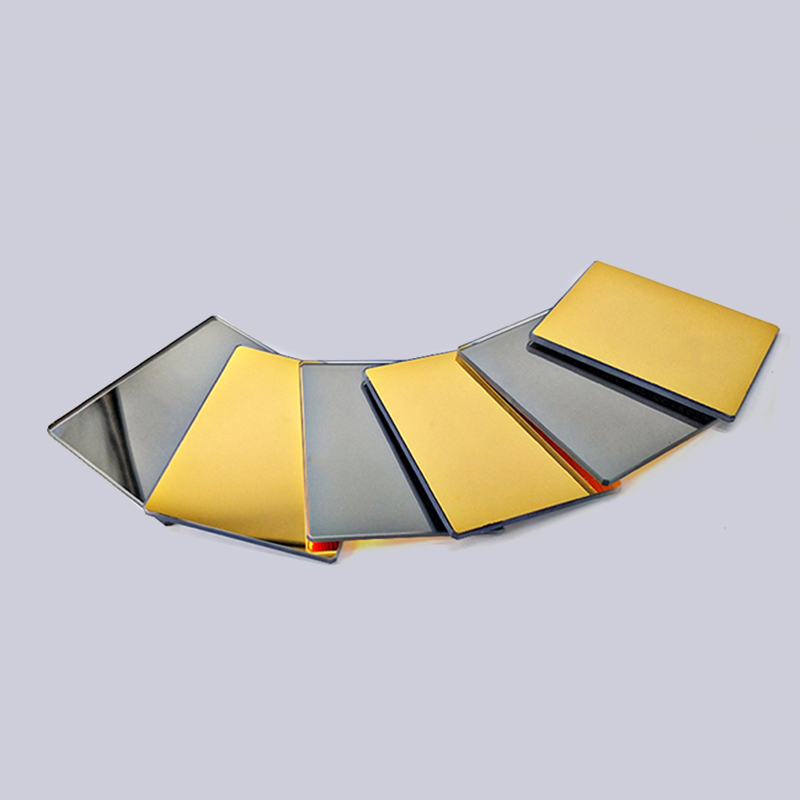
Coatings can significantly improve light guide block performance. Anti-reflection coatings reduce Fresnel reflection at entry and exit surfaces, increasing transmission and reducing ghost images. Reflective coatings can redirect light where total internal reflection is insufficient or where the optical design requires a controlled mirror surface. Filters or wavelength-selective coatings may be used in systems that require spectral control.
Coating design must match the angle of incidence. A coating that performs well at normal incidence may not perform the same way at steep angles. Since prism components often involve angled surfaces, coating performance must be evaluated under realistic conditions. Wavelength range is also important. A visible-light coating differs from a near-infrared coating or ultraviolet coating.
Adhesion and durability are practical concerns. A coating may meet optical specifications but fail if it scratches easily, peels during assembly, or degrades in humidity. Proper cleaning before coating, controlled deposition processes, and post-coating inspection are essential.
Surface treatments can also include controlled diffusion, edge blackening, metallization, protective coatings, or bonding preparation. In a light guide block, not every surface performs the same role. A professional manufacturer can process each surface according to its function, supporting both performance and cost efficiency.
Design for Assembly and Reliability
A light guide block must be designed not only for optical performance but also for practical assembly. If a part is difficult to handle, align, or secure, production problems may occur even when the optical design is good. Design for assembly considers features such as reference surfaces, chamfers, allowable contact areas, adhesive zones, and surface protection.
Reference surfaces help the assembly team position the component accurately. If the block has well-controlled mechanical datums, the optical pathway can be aligned more repeatably. This reduces assembly time and calibration effort. In high-volume production, repeatable assembly is a major cost and quality advantage.
Adhesive bonding requires careful planning. Adhesive can shrink, outgas, contaminate optical surfaces, or introduce stress. Bond line thickness, curing conditions, and adhesive placement should be considered. Some optical surfaces should remain free from adhesive overflow. The manufacturer can help by providing chamfers, masked areas, or surface finishes that support the assembly method.
Mechanical clamping also requires caution. Excessive pressure can cause stress birefringence, fracture, or alignment shift. Contact areas should be designed to avoid point loading. A robust light guide block design balances optical aperture, mechanical strength, and mounting needs.
Reliability testing may include thermal cycling, humidity exposure, vibration, shock, coating adhesion, and optical performance verification after stress. Automotive and industrial customers often require such validation. The company’s experience with certified quality systems supports this kind of reliability-focused development.
How Customers Can Specify a Light Guide Block
Clear specifications help ensure that the delivered light guide block matches the application. Customers should provide drawings, target dimensions, tolerances, material preferences, wavelength range, surface quality requirements, coating requirements, quantity, and environmental conditions. If possible, optical path diagrams or functional descriptions are also valuable.
For illumination applications, customers should describe the light source, input position, desired output area, required uniformity, and brightness target. For sensing applications, they should define acceptable stray light levels, detector location, and signal requirements. For automotive applications, temperature range, vibration expectations, and validation standards may be needed. For semiconductor applications, cleanliness and packaging requirements should be specified.
If the customer is unsure which tolerance level is necessary, engineering discussion can prevent over-specification. For example, an extremely tight surface flatness requirement may be unnecessary for a diffuse illumination system, while angle accuracy may be critical. Conversely, a system using a collimated beam may require stricter surface form control.
Good supplier communication can improve both performance and cost. The company can review manufacturability, suggest suitable materials, recommend surface treatments, and help align specifications with production reality. This collaborative approach is often more effective than simply sending a drawing for quotation.
Sustainability and Responsible Manufacturing
Modern optical manufacturing must consider not only precision and productivity but also environmental responsibility. ISO14001:2015 certification reflects a structured approach to environmental management. Precision optics production can involve water use, polishing materials, cleaning processes, coating materials, and packaging. Responsible management helps reduce waste and support sustainable operations.
Efficient manufacturing also supports sustainability by improving yield. When processes are stable, fewer parts are scrapped. When quality is consistent, customers experience fewer returns and less rework. When optical efficiency is high, final devices may consume less energy. A well-designed light guide block can therefore contribute indirectly to energy-saving system performance.
Durability is another sustainability factor. Components that last longer reduce replacement frequency and waste. In automotive, industrial, and semiconductor systems, reliable components help extend product life and reduce maintenance burden.
Why This Light Guide Block Is a Strong Choice
The light guide block combines optical function, compact structure, design flexibility, and precision manufacturing. It is suitable for customers who need more than a simple piece of glass. It is an engineered optical prism component that can improve light control, reduce assembly complexity, and support consistent product performance.
Its advantages over common alternatives include better alignment stability, compact optical integration, improved illumination control, customization flexibility, and compatibility with advanced coatings and surface treatments. When manufactured by a professional optical component supplier, it can help customers reduce system risk and improve final product quality.
Changzhou Haolilai Photo-Electricity Scientific and Technical Co., Ltd. strengthens the value of the product through long-term optical manufacturing experience, certified quality systems, engineering research platforms, patent achievements, international export experience, and cross-industry capability. The company’s background in laser optics, automotive optics, semiconductor optics, and consumer optics enables it to support diverse technical requirements.
For customers seeking optical components for demanding applications, the choice of supplier is as important as the product design. A light guide block must be made with accurate geometry, clean surfaces, controlled polishing, appropriate coatings, reliable inspection, and stable process management. These strengths help differentiate a precision product from ordinary glass processing.
Question and Answer Section
What is a light guide block?
A light guide block is a precision optical prism component used to guide, redirect, distribute, or condition light inside an optical system. It may use refraction, reflection, total internal reflection, polished surfaces, coatings, or controlled geometry to achieve the desired optical output.
How is a light guide block different from a simple glass block?
A simple glass block is usually only a transparent solid part. A light guide block is engineered for optical performance. Its angles, dimensions, surface finish, material, coatings, and edge treatments are controlled to guide light in a predictable way.
What are the main advantages of using a light guide block?
The main advantages include compact design, stable optical alignment, reduced component count, improved illumination control, high transmission, and better integration into complex systems. It can also reduce assembly complexity compared with separate mirrors and holders.
Why is surface quality important?
Surface quality affects scattering, brightness, clarity, and visible appearance. Scratches, digs, stains, or rough polishing can reduce optical efficiency and create unwanted light patterns. High-quality polishing supports stable and efficient light transmission.
Can the light guide block be customized?
Yes. Dimensions, angles, material, surface quality, coatings, chamfers, and inspection requirements can often be customized according to the application. Customization is especially useful for automotive, semiconductor, laser, and consumer optical systems.
What materials can be used?
Material selection depends on wavelength, temperature range, mechanical needs, and cost target. Optical glass is common for visible applications, while fused silica or specialized materials may be selected for ultraviolet, infrared, or high-stability requirements.
Why are coatings used on light guide blocks?
Coatings can reduce reflection, increase transmission, redirect light, filter selected wavelengths, or protect surfaces. The correct coating depends on wavelength, angle of incidence, environment, and optical function.
What industries use light guide blocks?
Light guide blocks can be used in automotive interiors, display systems, optical sensors, laser systems, semiconductor equipment, inspection tools, consumer electronics, and other precision optical assemblies.
Why is IATF16949 certification relevant?
IATF16949 is important for automotive supply chains because it emphasizes process control, traceability, risk management, and continuous improvement. For automotive optical components, this supports stable quality and long-term reliability.
How should customers request a quotation or technical evaluation?
Customers should provide drawings, dimensions, tolerances, material requirements, wavelength range, coating needs, surface quality specifications, application details, expected quantity, and environmental conditions. The more complete the information, the more accurate the technical evaluation will be.
Conclusion
A light guide block may look simple, but its value comes from precision engineering. It must guide light efficiently, fit accurately into an assembly, maintain stable performance, and meet the reliability expectations of the final product. Its success depends on material quality, geometric accuracy, surface polishing, coating control, cleanliness, inspection, and production consistency.
For applications in automotive interiors, semiconductor equipment, laser systems, and consumer optics, the component can provide meaningful advantages over more complicated assemblies or lower-precision alternatives. It can support compact design, reduce alignment risk, improve light uniformity, and enhance overall system reliability.
Changzhou Haolilai Photo-Electricity Scientific and Technical Co., Ltd. provides the manufacturing foundation needed for such a product. With decades of experience, certified management systems, advanced technical centers, patent achievements, and international production capability, the company is positioned to supply precision optical prism components that meet demanding customer requirements.
Choosing a high-quality light guide block is ultimately a decision about system performance. When optical pathways are controlled with precision, final products become brighter, more reliable, easier to assemble, and better suited to modern compact design. For customers seeking dependable optical components, the light guide block represents a practical and powerful solution.
References
Hecht, Eugene. Optics. Pearson Education.
Smith, Warren J. Modern Optical Engineering. McGraw-Hill Education.
Kingslake, Rudolf, and R. Barry Johnson. Lens Design Fundamentals. Academic Press.
Malacara, Daniel. Optical Shop Testing. Wiley.
ISO 9001:2015. Quality Management Systems Requirements.
ISO 14001:2015. Environmental Management Systems Requirements with Guidance for Use.
IATF 16949. Quality Management System Requirements for Automotive Production and Relevant Service Parts Organizations.



 苏公网安备32041102000130号