
 Search
 en
en English
 日本語
日本語 русский
 Español
 Deutsch
 中文简体
中文简体Content
- 1 1. The Role of Glass in the Modern Automotive Interior
- 2 2. Product Overview: Automotive Interior Glass Structural Components
- 3 3. Key Advantages Over Conventional Interior Materials
- 4 4. Technical Performance Characteristics
- 5 5. Main Application Areas in Vehicle Cabins
- 6 6. Manufacturing Strength Built on Precision Optical Expertise
- 7 7. Advanced Manufacturing Process
- 8 8. Process Control and Quality Assurance
- 9 9. Competitive Advantages for Automotive Customers
- 10 10. Product Performance Comparison
- 11 11. Design Considerations for Automotive Interior Glass
- 12 12. Reliability in Real Vehicle Environments
- 13 13. Supporting Intelligent Cockpit Development
- 14 14. Environmental and Production Responsibility
- 15 15. Why Manufacturer Experience Matters
- 16 16. Customization and Engineering Collaboration
- 17 17. Practical Benefits for Vehicle Brands and Tier Suppliers
- 18 18. Q&A Section
- 18.1 Q1: What are automotive interior glass structural components?
- 18.2 Q2: Why is glass preferred over plastic in many interior applications?
- 18.3 Q3: Can these glass components be customized?
- 18.4 Q4: What coatings can be applied to automotive interior glass?
- 18.5 Q5: Why is edge processing important?
- 18.6 Q6: What makes Changzhou Haolilai Photo-Electricity Scientific and Technical Co., Ltd. suitable for this product?
- 18.7 Q7: Are automotive interior glass structural components suitable for intelligent cockpits?
- 18.8 Q8: How is product quality controlled?
- 18.9 Q9: What reliability tests are commonly relevant?
- 18.10 Q10: How do these components improve the user experience?
- 19 19. Conclusion
- 20 References
- 21 Product: Automotive Interior Glass Structural Components
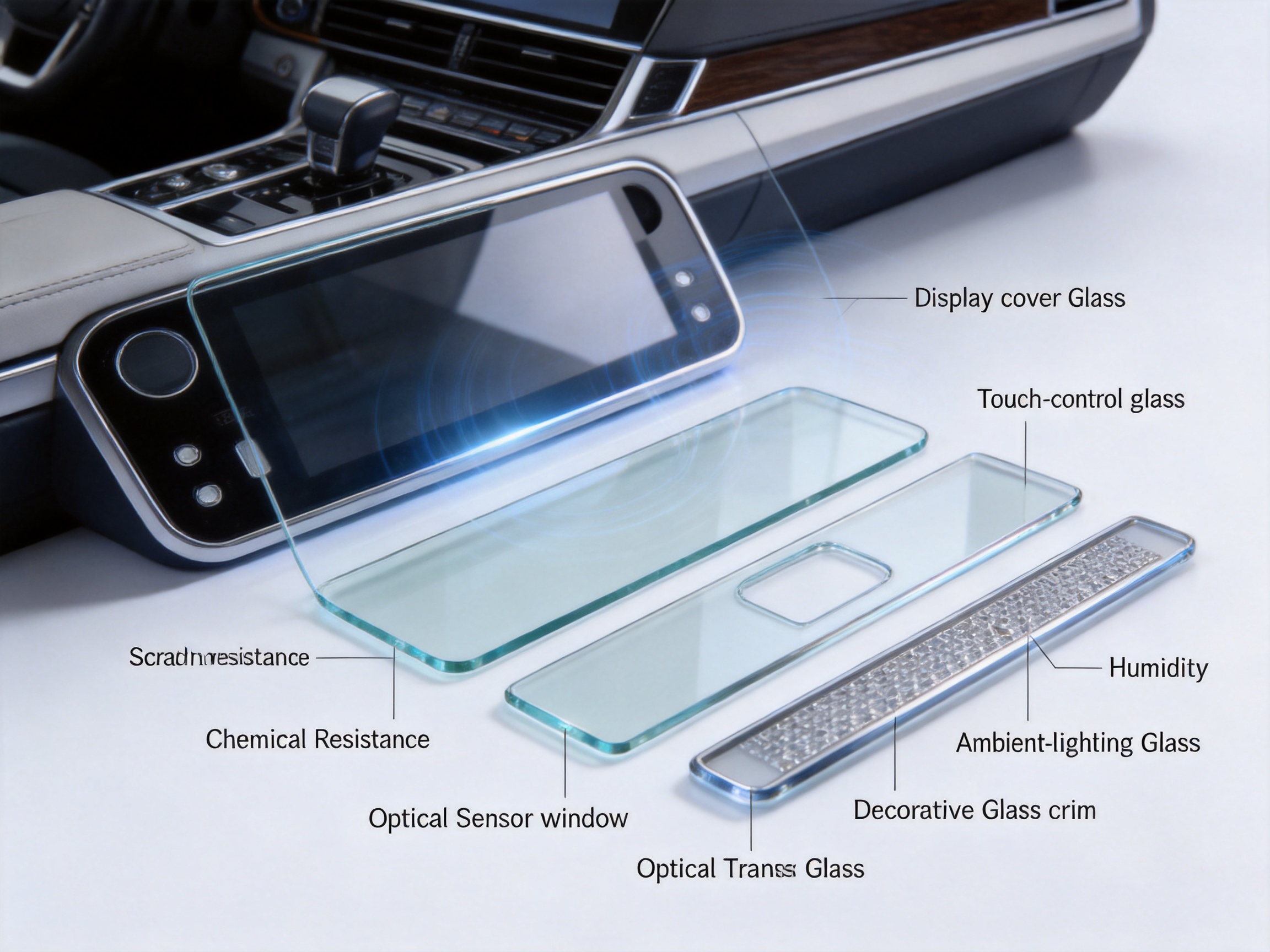
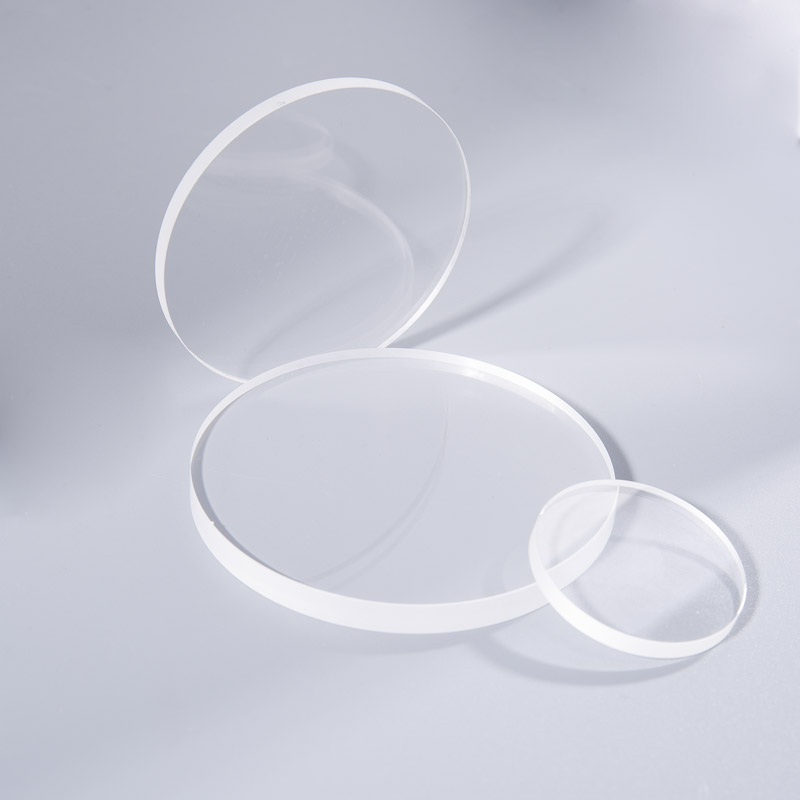
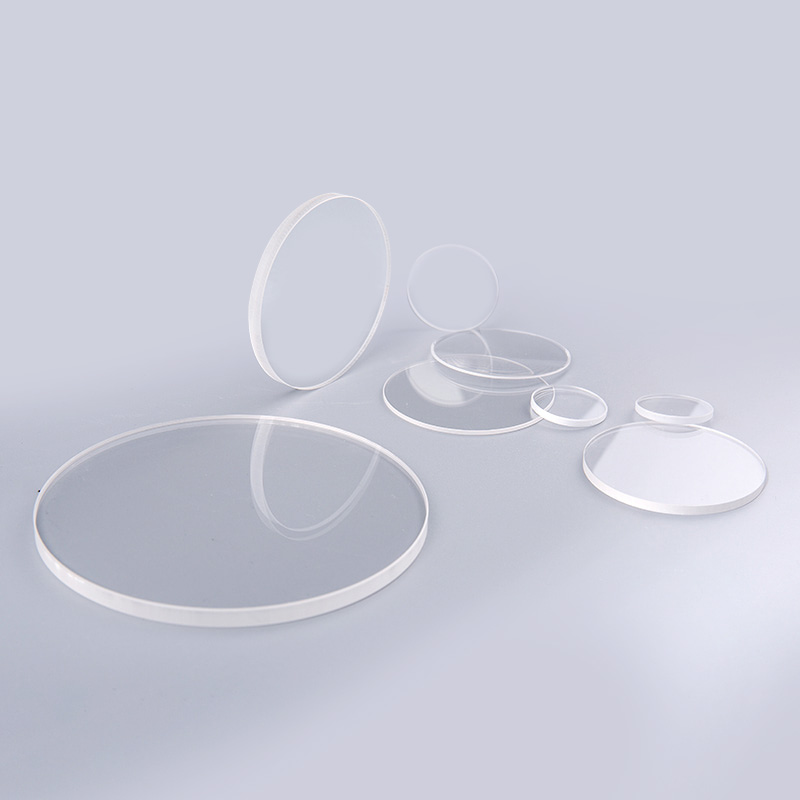
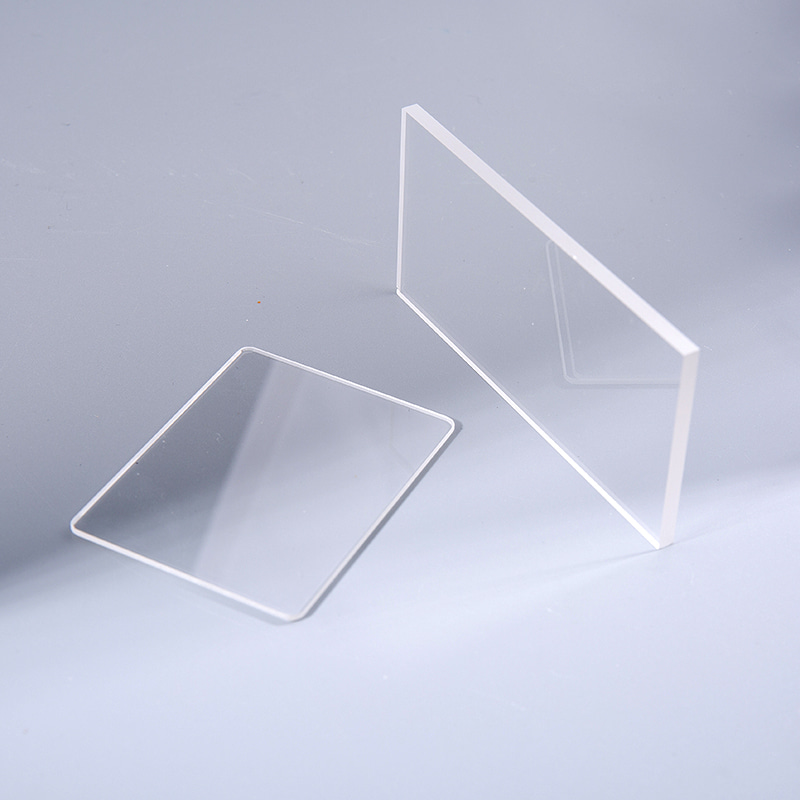
Automotive interior glass structural components are increasingly important in the transformation of vehicle cabins from purely mechanical environments into intelligent, connected, premium, and highly functional spaces. These components may appear as display cover glass, decorative glass panels, center console glass, instrument cluster windows, touch-control substrates, optical protection windows, sensor cover glass, ambient-lighting glass structures, or precision interior glass modules integrated with electronic and optical systems. Unlike ordinary decorative materials, automotive interior glass must combine optical clarity, mechanical strength, dimensional accuracy, surface durability, chemical resistance, and reliable long-term performance under demanding vehicle conditions.
Changzhou Haolilai Photo-Electricity Scientific and Technical Co., Ltd. develops and manufactures precision optical components and automotive optical products with a strong foundation in optical processing, coating, polishing, grinding, and quality control. Founded in 1998 and located in Changzhou, Jiangsu, China, the company has built extensive experience in precision optical manufacturing for automotive optics, laser optics, semiconductor optics, and consumer optics. Its automotive interior glass structural components benefit from this background, offering a combination of optical-grade processing and automotive-grade reliability.
Automotive Interior Glass Structural Components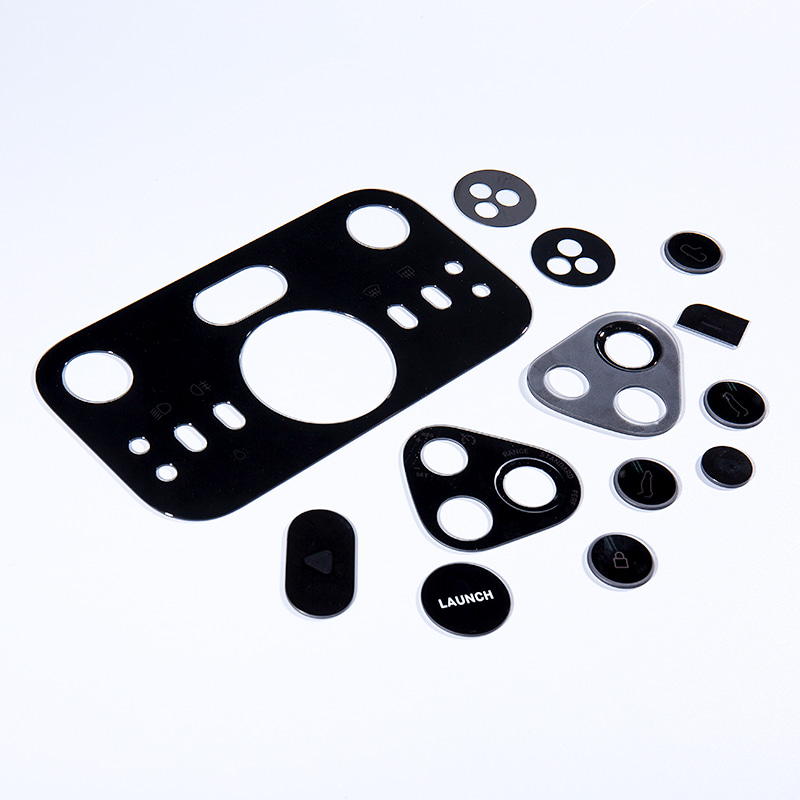
1. The Role of Glass in the Modern Automotive Interior
In the past, automotive interiors were dominated by plastic panels, mechanical switches, metal trims, fabric surfaces, and small isolated displays. Today, the interior is a digital cockpit. Drivers and passengers interact with touch screens, curved displays, capacitive control panels, smart lighting systems, integrated sensors, heads-up display modules, and multifunction decorative surfaces. Glass has become one of the preferred materials for these applications because it supports high light transmission, elegant appearance, scratch resistance, stable geometry, and precise integration with optical and electronic functions.
Automotive interior glass structural components are not merely cover plates. They are engineered parts that protect displays, transmit images, resist abrasion, support touch-control performance, withstand temperature variation, and maintain visual quality throughout the service life of a vehicle. They must be compatible with adhesives, coatings, printed borders, sensors, illumination modules, and mechanical housings. They must also meet strict automotive requirements for safety, durability, and consistency.
Compared with many polymer alternatives, glass provides superior hardness and a more premium tactile feeling. It resists scratches from keys, dust, fingernails, cleaning cloths, and daily use more effectively than many plastics. Its surface can be polished to excellent smoothness, supporting clear image quality and comfortable touch interaction. Glass is also dimensionally stable, which is important when large display panels, narrow bezels, and complex assemblies must maintain alignment over years of vibration, heat, cold, and humidity.
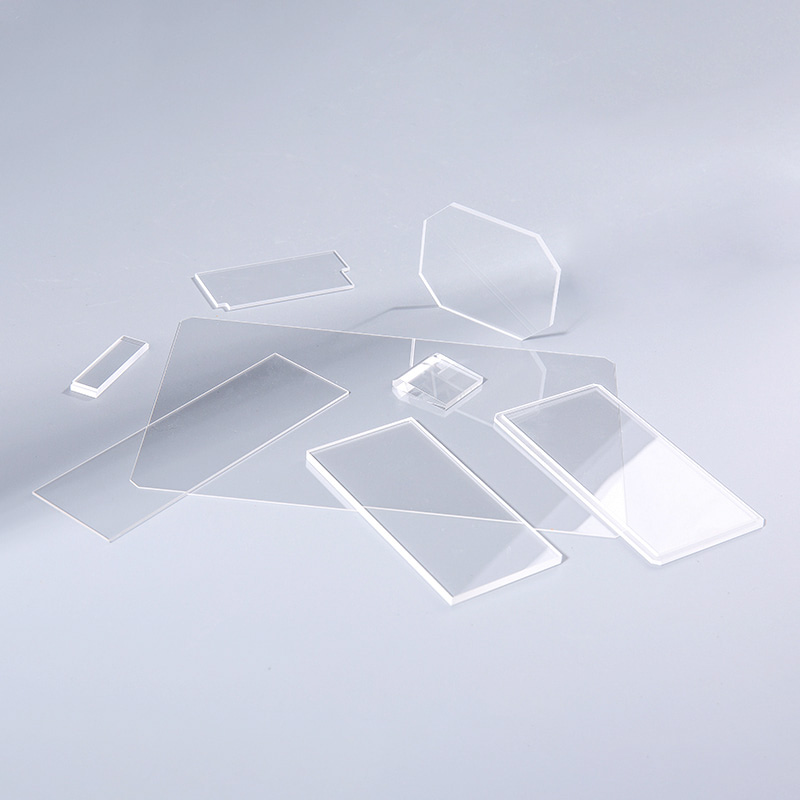
Interior glass can also be processed into different shapes and functions. It can be flat, curved, chamfered, drilled, slotted, polished, coated, strengthened, printed, or combined with optical films. This flexibility allows automakers and Tier 1 system suppliers to design cockpit surfaces that are both attractive and highly functional. As vehicle cabins become more like interactive digital environments, precision glass components serve as a bridge between mechanical structure, optical performance, user interface, and brand experience.
2. Product Overview: Automotive Interior Glass Structural Components
Automotive interior glass structural components are precision-manufactured glass parts designed for integration into vehicle cabin systems. They may be used in center information displays, instrument panels, passenger displays, rear-seat entertainment systems, touch panels, climate-control modules, interior mirror systems, optical sensor windows, camera protective panels, lighting guides, and decorative structural areas. Depending on the application, the component may be required to provide optical transmission, mechanical support, surface protection, aesthetic enhancement, or a combination of these functions.
The product category requires more than conventional glass cutting. Each component must be manufactured according to strict dimensional tolerances, surface-quality standards, edge safety requirements, coating specifications, and automotive reliability criteria. Even small defects, such as chips, scratches, coating nonuniformity, waviness, stress concentration, stains, or dimensional drift, can affect assembly performance and end-user perception. Therefore, professional optical processing and automotive quality management are essential.
Changzhou Haolilai Photo-Electricity Scientific and Technical Co., Ltd. applies its precision optical manufacturing capabilities to automotive interior glass structures. The company’s experience in optical lenses, prisms, mirrors, wafers, and other optical components supports a strong understanding of surface accuracy, material behavior, polishing control, coating uniformity, and inspection methods. These capabilities are particularly valuable in automotive interiors, where visual performance and structural durability must coexist.
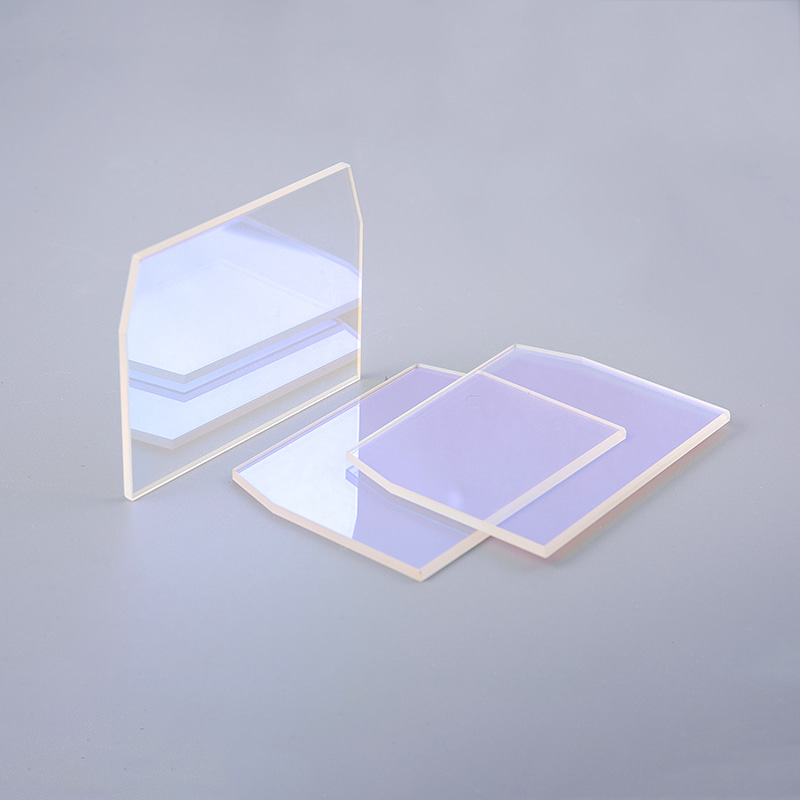
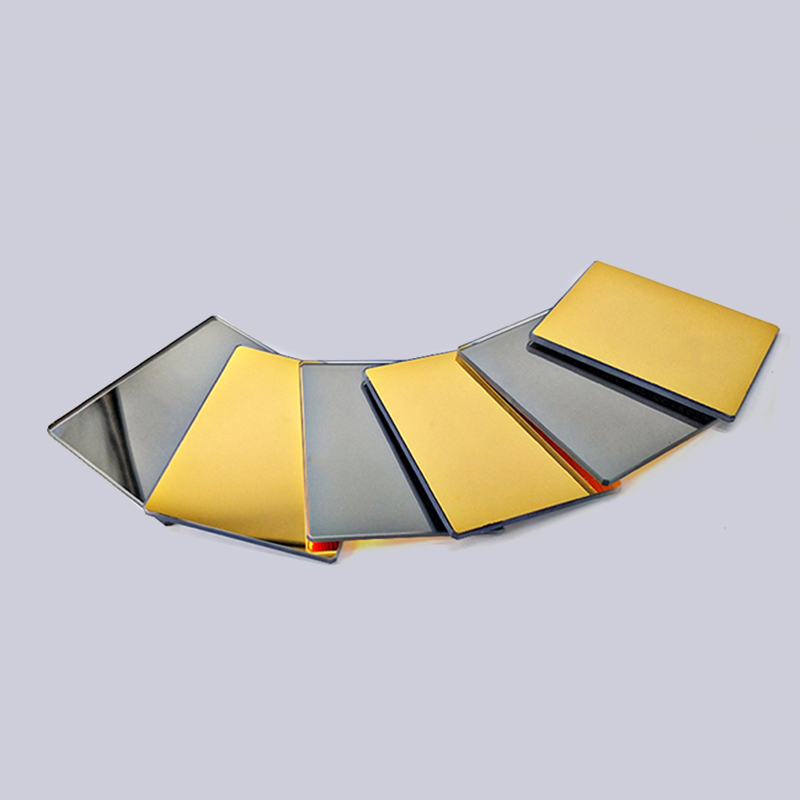
Typical features of these glass structural components may include high surface hardness, smooth polished edges, high light transmission, low distortion, controlled reflectance, customized shape, printed decorative borders, anti-fingerprint coating, anti-glare surface treatment, anti-reflective coating, chemical strengthening, and compatibility with touch or display modules. Components can be customized according to customer drawings, assembly requirements, optical specifications, and application environments.
3. Key Advantages Over Conventional Interior Materials
One of the strongest advantages of automotive interior glass structural components is their excellent scratch resistance. Vehicle interiors are exposed to repeated contact from fingers, rings, cleaning tools, dust particles, and everyday objects. Plastic cover panels can become hazy, scratched, or worn after repeated use, especially in high-touch areas such as infotainment screens and climate-control panels. Glass, especially strengthened glass with precision-polished surfaces, maintains a cleaner and more premium appearance for a longer period.
Another advantage is optical clarity. Displays in vehicles must remain readable under challenging lighting conditions, including direct sunlight, night driving, high contrast display modes, and changing cabin reflections. Precision glass can provide excellent transparency, low haze, and controlled surface flatness. When combined with anti-reflective or anti-glare coatings, it can reduce unwanted reflections and improve readability. This helps enhance driver comfort and supports safer interaction with digital systems.
Glass also provides superior thermal and dimensional stability compared with many polymer materials. Automotive interiors can experience high temperatures when parked in summer sun and low temperatures in winter conditions. Materials expand and contract, and dimensional instability can cause warping, delamination, light leakage, assembly gaps, or touch-function errors. Properly selected and processed glass maintains stable geometry, helping preserve alignment in display modules and decorative assemblies.
Chemical resistance is another important benefit. Vehicle interior surfaces may be exposed to cleaning agents, hand oils, cosmetics, sunscreen, disinfectants, beverage residues, and humidity. Glass is naturally resistant to many chemicals and can be further enhanced through specialized coatings. This helps maintain surface quality and reduces the risk of staining, clouding, or degradation. For shared vehicles, commercial fleets, and high-use passenger cars, this durability is especially valuable.
The tactile experience of glass also differentiates it from many competitors’ materials. A smooth glass surface gives users a premium, precise, and modern feeling. In electric vehicles and intelligent cockpits, where digital interfaces are central to the brand image, touch quality and visual refinement are essential. Glass supports seamless design concepts, black-panel effects, hidden-until-lit icons, and integrated surfaces that give the cabin a clean and advanced appearance.
Glass can also contribute to better integration of optical and electronic functions. It can be manufactured with controlled thickness, surface quality, optical coating, printing, and edge geometry. These attributes are useful for capacitive touch panels, optical sensors, display cover modules, and lighting features. In comparison, lower-grade materials may introduce optical distortion, uneven color, poor surface durability, or inconsistent assembly behavior.
4. Technical Performance Characteristics
Automotive interior glass structural components must satisfy a broad set of technical requirements. These typically include dimensional precision, surface quality, edge strength, coating durability, optical performance, adhesion compatibility, temperature resistance, humidity resistance, vibration resistance, and long-term reliability. The exact specification depends on the vehicle program and application, but the general performance demand is high because these components are visible to users and integrated into critical cabin systems.
Dimensional precision is essential because modern interiors often use tight assembly spaces and narrow visual borders. A glass component must fit into a module without causing stress concentration or gaps. Thickness control, outline accuracy, hole position, notch geometry, and chamfer consistency all influence assembly quality. Precision CNC machining and optical inspection help ensure that every component matches customer drawings and assembly requirements.
Surface quality is equally important. Scratches, pits, stains, coating defects, or polishing marks can be highly visible in a display or glossy decorative panel. Optical-grade processing helps control these defects. For visible surfaces, high cosmetic standards are required. For optical windows or sensor covers, surface imperfections can affect light transmission, image quality, or sensor accuracy. Therefore, manufacturing must include careful handling, clean processing, and strict final inspection.
Edge quality has both functional and safety significance. Poorly processed edges can create stress points, reduce strength, cause chipping during assembly, or pose handling risks. Precision edge grinding, chamfering, beveling, and polishing improve strength and safety. For curved or complex-shaped parts, edge processing becomes more demanding because the tool path and stress distribution must be carefully controlled.
Coating performance may include anti-reflective, anti-glare, anti-fingerprint, hydrophobic, oleophobic, decorative, or optical filtering functions. Coatings must be uniform, durable, and compatible with automotive environmental requirements. They should resist abrasion, humidity, temperature cycling, cleaning chemicals, and long-term use. A high-quality coating can greatly improve user experience by reducing fingerprints, improving visibility, and making surfaces easier to clean.
Mechanical reliability is critical. Automotive interior glass may be exposed to vibration, shock, pressure, cleaning force, and assembly stress. Strengthening processes, controlled edge geometry, and careful material selection help improve resistance to breakage. For safety-related applications, the product design must consider fracture behavior, bonding strategy, module housing, and applicable vehicle requirements.
5. Main Application Areas in Vehicle Cabins
One major application is display cover glass. Large center displays, digital instrument clusters, passenger entertainment screens, and rear-seat displays require protective cover glass that preserves image quality while resisting scratches and fingerprints. These parts may be flat or slightly curved, with black printed borders, camera holes, sensor windows, or special coatings. A premium display cover glass can significantly influence the perceived quality of the entire cabin.
Another application is touch-control glass for climate panels, multimedia controls, seat-control modules, and center-console interfaces. These components must provide smooth touch response, stable capacitance compatibility, accurate printing, and durable surface protection. They often require decorative printing and hidden icon effects, where symbols become visible only when backlit. The glass must support both aesthetics and reliable electronic function.
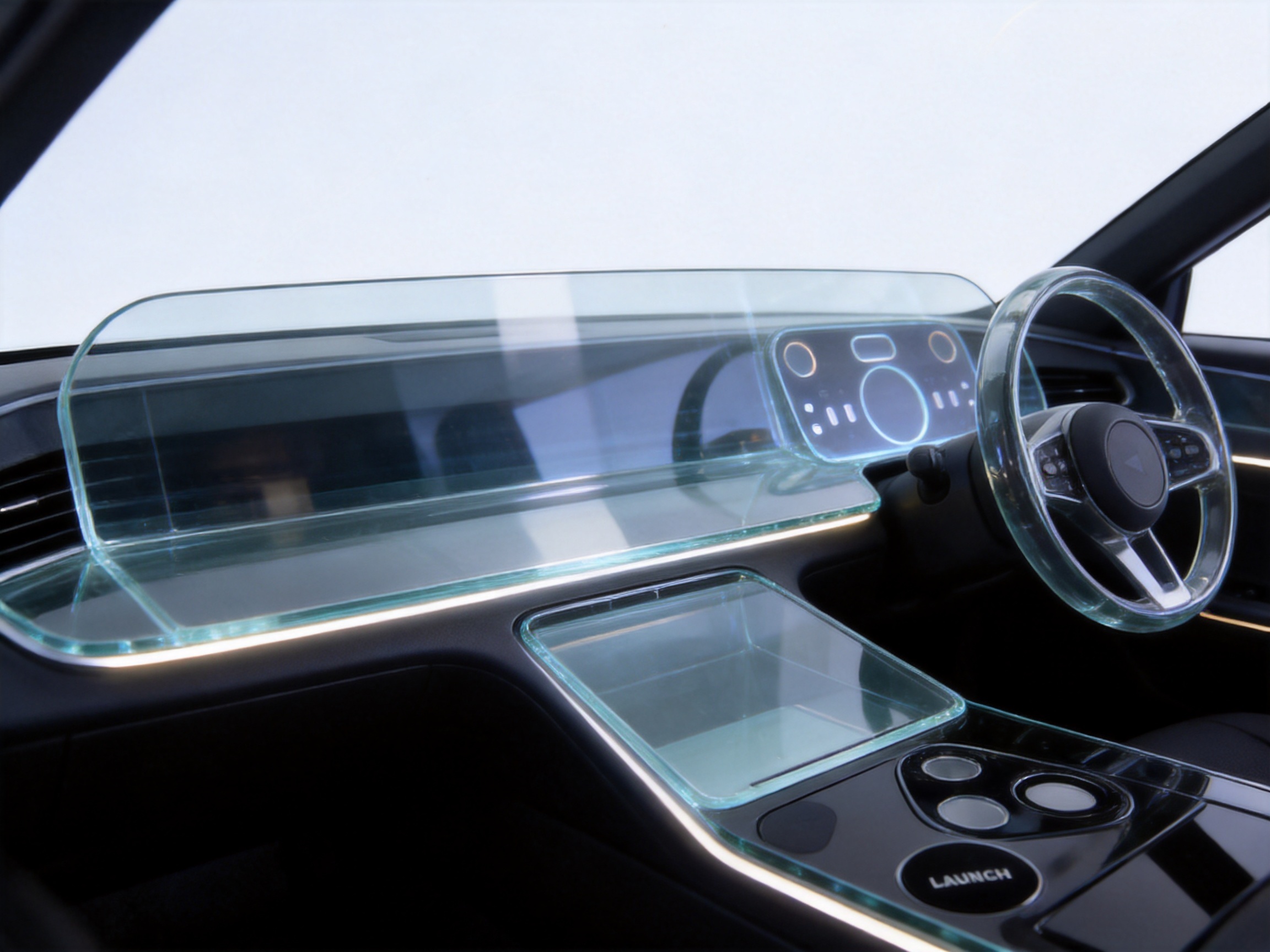
Instrument cluster and dashboard glass components are also common. These parts protect displays or optical modules while supporting low reflection and high clarity. In advanced cockpit designs, the instrument panel may be integrated with wide display glass spanning a large area. Such designs require excellent flatness, dimensional control, and uniform appearance to prevent visual distortion or assembly mismatch.
Interior mirror and optical sensor modules may use precision glass windows to protect cameras, light sensors, rain sensors, driver-monitoring sensors, or other optical devices. These windows require high optical quality, controlled transmission, and stable coating performance. Any distortion, haze, or contamination can affect sensor accuracy. A manufacturer with optical component expertise is well positioned to support these demanding applications.
Decorative interior glass structures are increasingly used in premium vehicles and electric vehicles. Glass can be printed, tinted, coated, or combined with lighting to create distinctive design effects. It may be used in door trims, center consoles, dashboard panels, ambient-lighting covers, and smart decorative surfaces. Because these components are highly visible, cosmetic quality, color consistency, and edge finishing are extremely important.
Glass may also serve in heads-up display related assemblies, protective optical windows, or light-guiding structures. In these cases, optical performance becomes especially important. Low distortion, accurate surface processing, and coating control help preserve optical image quality. Experience in optical mirrors, lenses, prisms, and wafers supports the development of these specialized automotive components.
6. Manufacturing Strength Built on Precision Optical Expertise
The production of automotive interior glass structural components requires a manufacturing system that combines optical precision with automotive industrial discipline. Changzhou Haolilai Photo-Electricity Scientific and Technical Co., Ltd. has developed such a foundation through decades of work in precision optical components. The company was founded in 1998 and has grown into a professional manufacturer with more than 300 employees, a 35,000 square meter facility, and exports to more than 20 countries.
The company’s background in optical flat mirrors, optical prisms, optical spherical mirrors, optical lenses, wafers, and other precision components is relevant to automotive glass because these products demand close control over geometry, surface condition, and optical behavior. Processing optical components requires careful selection of raw materials, controlled grinding, polishing, cleaning, coating, inspection, and packaging. These same disciplines are valuable for vehicle interior glass, where appearance and performance must be consistent at scale.
Automotive manufacturing also requires documented quality systems and process repeatability. The company has obtained ISO9001:2015, ISO14001:2015, and IATF16949 certifications. IATF16949 is particularly important for automotive supply chains because it emphasizes defect prevention, continuous improvement, risk management, traceability, and customer-specific requirements. These systems support stable mass production and help customers reduce quality risks.
In addition, the company has established the Jiangsu Precision Optical Lens Engineering Technology Center and Jiangsu Enterprise Technology Research Center. These technical platforms support process development, product engineering, testing, and improvement. The company has also obtained multiple invention patents, utility model patents, and high and new technology product recognitions. This indicates a commitment to research, innovation, and technical capability rather than simple commodity processing.
For automotive interior glass components, these strengths translate into customized engineering support, process control, advanced inspection, and the ability to manage both optical and structural requirements. Customers can benefit from a supplier that understands not only glass shape but also light, coating, surface quality, assembly behavior, and quality documentation.
7. Advanced Manufacturing Process
The manufacturing process begins with material selection. Different applications may require different glass types, thicknesses, thermal properties, optical transmission levels, and strengthening capability. The raw material must be evaluated for internal defects, inclusions, stress, color consistency, and surface condition. Selecting stable and suitable glass is the first step toward reliable product performance.
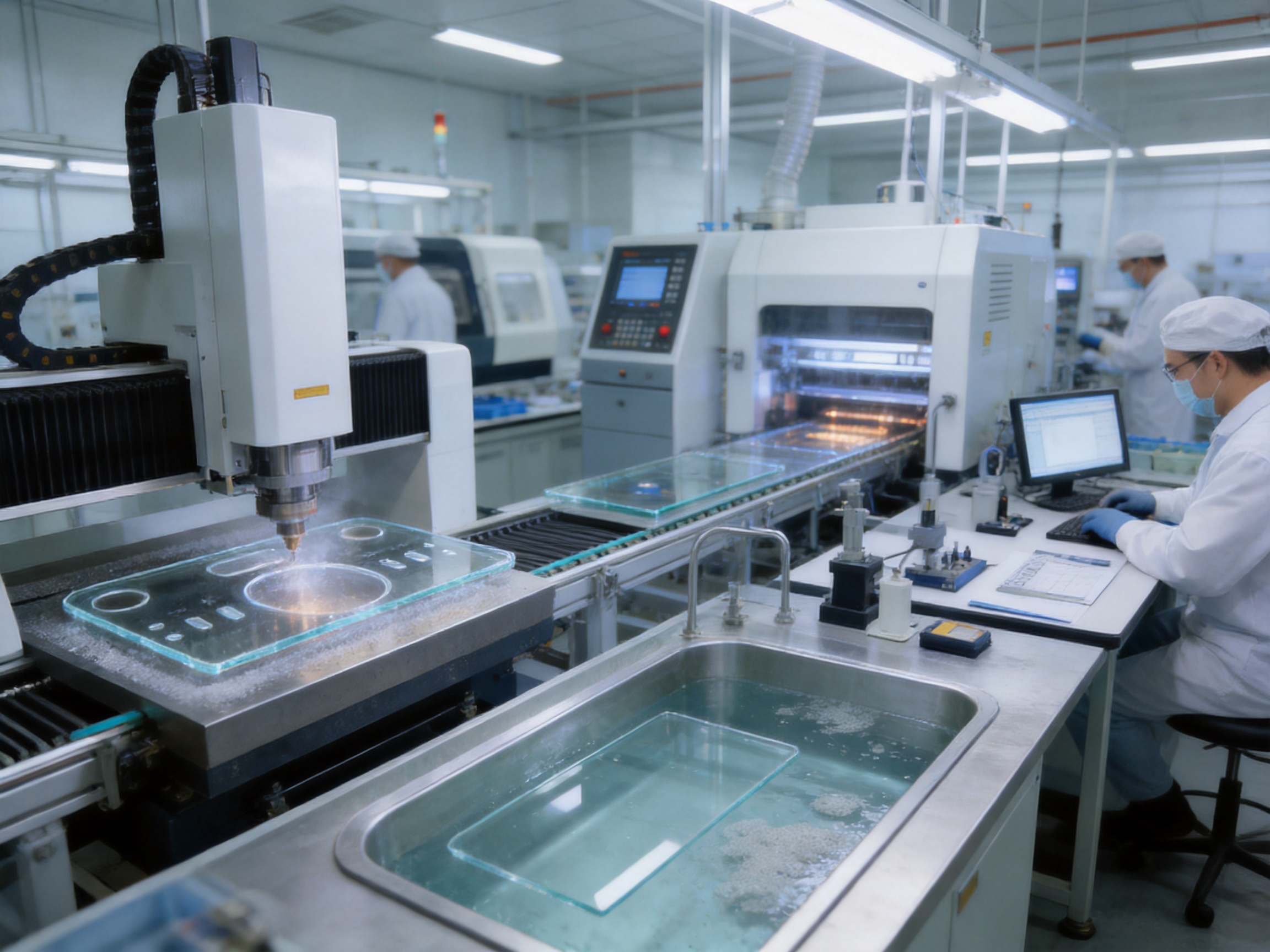
After material selection, glass is cut or shaped according to the required outline. Depending on the part design, processes may include precision cutting, CNC machining, drilling, slotting, contour forming, or edge profiling. Automotive interior parts often have complex geometries, including rounded corners, holes for sensors, notches for assembly, and decorative shapes. Accurate machining helps ensure smooth downstream assembly.
Grinding and edge finishing are then performed to remove sharp edges, correct geometry, and improve strength. Edge defects are a common source of glass failure, so controlled grinding and polishing are essential. Smooth chamfers and polished edges reduce microcracks and improve safety during handling and installation. For visible glass edges, polishing also improves appearance.
Surface polishing may be required to achieve the desired flatness, smoothness, and optical quality. Precision polishing removes surface defects and improves visual performance. In display applications, polished glass helps reduce haze and image distortion. In optical sensor applications, high-quality surfaces help preserve light transmission and sensing accuracy. Polishing parameters must be controlled to avoid waviness, local distortion, or uneven removal.
Cleaning is a critical step between processes. Glass surfaces can easily collect particles, oil, polishing residues, and other contaminants. Ultrasonic cleaning, purified water rinsing, and controlled drying may be used to ensure surface cleanliness before coating, printing, strengthening, or final inspection. Cleanliness is especially important for coated products and optical assemblies, because contaminants can cause coating defects, adhesion failures, or visible stains.
Decorative printing may be applied for borders, icons, logos, light-shielding areas, or hidden display effects. In automotive interiors, printing quality affects both appearance and function. Printed borders must be uniform, accurately positioned, and durable. Ink systems must be compatible with glass, adhesives, coatings, backlighting, temperature exposure, and humidity. Accurate registration is necessary when printing aligns with sensors, displays, or mechanical structures.
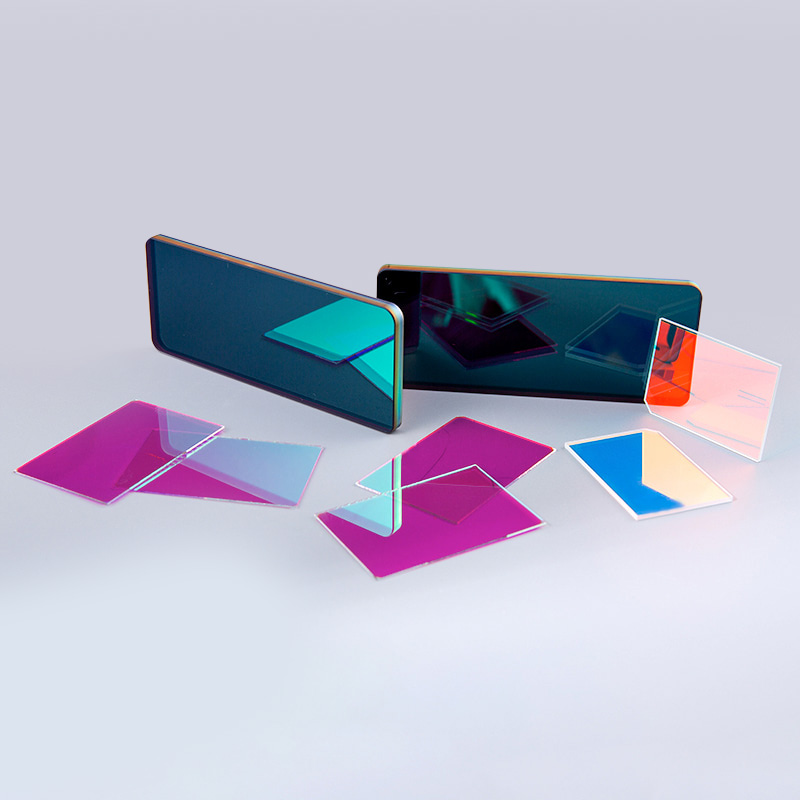
Coating processes can add important functional properties. Anti-reflective coatings improve display readability by reducing surface reflections. Anti-glare treatments diffuse reflections and improve visibility under strong light. Anti-fingerprint coatings reduce oil adhesion and make cleaning easier. Hydrophobic and oleophobic coatings support daily usability. Optical filtering coatings may be used for sensors or special display effects. Coating uniformity, adhesion, abrasion resistance, and environmental reliability must be carefully verified.
Chemical strengthening or thermal treatment may be used to improve mechanical resistance, depending on the glass type and product requirements. Chemical strengthening introduces compressive stress at the surface, increasing resistance to scratches and impact-related failure. The strengthening process must be controlled to achieve the desired depth of layer and surface compression without causing distortion or dimensional issues.
Final inspection includes dimensional measurement, surface defect inspection, coating evaluation, optical testing, edge quality assessment, and packaging verification. Automotive customers may also require reliability testing such as thermal cycling, humidity exposure, abrasion tests, chemical resistance tests, adhesion tests, and mechanical strength tests. Traceability systems help track material batches, process conditions, inspection results, and shipment information.
8. Process Control and Quality Assurance
Automotive interior glass components must be manufactured with repeatability. A single high-quality sample is not enough; every production batch must meet specification. Process control begins with documented work instructions, trained operators, calibrated equipment, controlled environments, and clear acceptance criteria. Quality planning may include advanced product quality planning, failure mode and effects analysis, control plans, measurement system analysis, and production part approval documentation when required by automotive customers.
The company’s IATF16949 certification supports automotive quality management. This standard encourages systematic risk control, customer requirement management, defect prevention, and continuous improvement. For glass products, this can involve controlling raw material variability, tool wear, polishing conditions, cleaning quality, coating parameters, inspection lighting, packaging protection, and logistics conditions.
Surface inspection is especially important because automotive interior glass is highly visible. Inspection may be performed under controlled lighting conditions to identify scratches, chips, stains, coating spots, printing defects, bubbles, haze, or foreign particles. Because customer expectations for interior appearance are high, cosmetic criteria must be clearly defined and consistently applied.
Dimensional inspection may use precision gauges, coordinate measuring systems, optical measurement equipment, thickness measurement tools, and profile inspection methods. These measurements confirm outline accuracy, hole location, thickness tolerance, flatness, edge geometry, and other critical dimensions. Tight dimensional control helps ensure smooth assembly into display modules, housings, decorative panels, or optical systems.
Coating inspection may include visual checks, spectral measurement, contact-angle testing, abrasion testing, adhesion testing, and environmental testing. Anti-fingerprint coatings, for example, should maintain surface performance after repeated touch and cleaning. Anti-reflective coatings should maintain optical uniformity and adhesion under temperature and humidity exposure. These tests help ensure that coating performance is not only attractive at the factory but durable in real use.
Packaging is also part of quality assurance. Precision glass components can be damaged by impact, friction, dust, or improper stacking. Protective films, separators, clean packaging, shock-resistant cartons, and careful labeling help maintain quality during storage and transport. For export to more than 20 countries, stable packaging and logistics management are important parts of customer satisfaction.
9. Competitive Advantages for Automotive Customers
Compared with suppliers that focus only on simple glass cutting, a precision optical manufacturer offers deeper expertise in surface control, optical clarity, polishing, coating, and measurement. This is a major advantage for automotive interior glass structural components because these parts are not just mechanical covers. They are visual, tactile, optical, and structural interfaces between passengers and vehicle technology.
One competitive advantage is the ability to support customized specifications. Automotive programs often require unique shapes, thicknesses, coatings, prints, optical windows, and assembly features. A supplier with strong engineering capability can work from customer drawings and application requirements to develop manufacturable solutions. This can reduce development time and improve program reliability.
Another advantage is process integration. Cutting, grinding, polishing, cleaning, coating, printing, strengthening, inspection, and packaging must be coordinated to avoid defects. A manufacturer with broad internal capability can better control quality, reduce handling risk, and improve production efficiency. Process integration also helps protect intellectual property and maintain stable communication during development.
Automotive-grade quality management is another key differentiator. With ISO9001:2015, ISO14001:2015, and IATF16949 certifications, the company demonstrates its ability to operate within recognized management systems. For automotive customers, this reduces supplier risk and supports long-term cooperation. Environmental management certification also reflects attention to sustainable and responsible production.
Technical innovation is also important. The company’s technology centers, patent portfolio, and high-tech enterprise status indicate that it invests in engineering development. Automotive interiors are evolving quickly, with curved displays, integrated smart surfaces, driver-monitoring systems, and advanced optical modules. Suppliers must be able to adapt to new requirements rather than merely repeat old processes.
Cost-performance balance is another advantage. Customers need premium quality, but automotive production also requires cost control, stable delivery, and scalable manufacturing. A manufacturer located in China’s strong industrial supply chain can combine precision processing capability with efficient production organization. This helps customers obtain competitive value without compromising core quality requirements.
10. Product Performance Comparison
| Performance Factor | Automotive Interior Glass Structural Components | Common Plastic Interior Panels | Basic Decorative Glass |
|---|---|---|---|
| Scratch Resistance | High surface hardness and strong resistance to daily wear | Often lower and more prone to visible scratches | Moderate to high, depending on processing |
| Optical Clarity | High clarity, low haze, and suitable for display or sensor use | May show haze, yellowing, or optical distortion over time | Variable, often not optimized for optical applications |
| Dimensional Stability | Excellent stability under heat, cold, and humidity | Higher risk of warping or expansion | Good, but tolerance control may be limited |
| Surface Functionality | Can support anti-reflective, anti-glare, anti-fingerprint, and optical coatings | Coating options exist but durability can be limited | Possible, but may lack automotive-grade process control |
| Premium Appearance | Smooth, elegant, modern, and suitable for intelligent cockpits | Can look less premium after wear | Good appearance but not always structurally optimized |
| Automotive Reliability | Designed for automotive environmental and quality requirements | Application-dependent and may degrade faster | Depends on supplier capability and process control |
| Customization | Supports precision shapes, holes, printing, coatings, and special optical requirements | Highly moldable but may sacrifice optical and scratch performance | Possible, but may be limited by processing accuracy |
11. Design Considerations for Automotive Interior Glass
When designing automotive interior glass structural components, engineers must consider the complete application environment. The part cannot be evaluated only as a separate piece of glass. It must be designed as part of an assembly that includes display panels, sensors, adhesives, housings, lighting, printed layers, electrical interfaces, mechanical supports, and user interaction requirements.
Thickness selection is one of the first design decisions. Thicker glass may improve rigidity and perceived solidity, but it can increase weight and affect optical stack design. Thinner glass reduces weight and may support slimmer modules, but it may require more careful strengthening and support. The correct thickness depends on span, mounting method, impact requirement, touch function, and optical performance.
Edge design is also critical. Sharp corners and poorly controlled holes can create stress concentration. Rounded corners, polished edges, proper chamfers, and optimized hole geometry help improve strength. For large display glass, edge treatment must also support safe handling and assembly. A small edge defect can become a failure point during thermal cycling, vibration, or mechanical loading.
Surface treatment should be selected according to the use case. A center display may require anti-reflective and anti-fingerprint performance. A decorative panel may prioritize color consistency and scratch resistance. A sensor window may require a specific transmission band and minimal optical distortion. A climate-control touch panel may require durable printing and stable capacitive response. Because each function has different priorities, early communication between customer and supplier is important.
Printing design must consider appearance, backlighting, alignment, and durability. Black borders can hide adhesives and electronic structures, while icons can support user interaction. However, printed layers must not interfere with touch signals or optical sensors unless designed to do so. Ink thickness, opacity, color, and curing conditions must be controlled.
Assembly compatibility is another major consideration. Glass may be bonded with optical clear adhesive, pressure-sensitive adhesive, structural adhesive, gasket systems, or mechanical clips. The glass surface and coating must be compatible with the chosen bonding method. If the adhesive interacts poorly with coatings or printed layers, delamination or cosmetic defects may occur. Therefore, material compatibility testing is essential.
12. Reliability in Real Vehicle Environments
Vehicle interiors are harsh environments for visible components. During summer, a parked vehicle can reach high cabin temperatures. During winter, it may experience freezing conditions. Components may undergo rapid temperature changes when climate control is activated. Humidity, condensation, vibration, sunlight, cleaning chemicals, and repeated touch all contribute to material stress.
Automotive interior glass structural components must remain stable through these conditions. They should not warp, discolor, delaminate, lose coating function, develop visible stains, or suffer edge cracking under normal use. The combination of proper material selection, strengthening, polishing, coating, and quality testing helps support this reliability.
Thermal cycling tests are used to evaluate resistance to repeated expansion and contraction. Humidity tests help identify coating adhesion issues, printing instability, or chemical vulnerability. Abrasion tests simulate repeated cleaning and touch. Chemical resistance tests evaluate exposure to cleaners, oils, cosmetics, and other substances. Mechanical tests may assess impact resistance, bending strength, or assembly stress tolerance.
Vibration resistance is also relevant because vehicles constantly experience road-induced vibration. Even if the glass itself is stable, poor assembly design can create stress or noise. Therefore, glass components should be considered in relation to module structure, adhesive thickness, housing stiffness, and thermal expansion of surrounding materials.
Long-term visual quality is essential. A vehicle owner may interact with a center display or console glass thousands of times over the vehicle’s life. If the surface becomes scratched, stained, or difficult to clean, the user’s perception of quality declines. High-quality glass with durable coating helps maintain a new and refined appearance for longer.
13. Supporting Intelligent Cockpit Development
The intelligent cockpit is one of the most important trends in automotive design. It combines display systems, touch control, voice interaction, driver monitoring, passenger entertainment, connectivity, and personalized lighting. Glass plays a central role in this trend because it supports seamless visual surfaces, clear display protection, sensor integration, and premium tactile interfaces.
Large integrated displays require glass that can cover wide areas while maintaining uniform appearance. Curved and shaped glass structures may be used to follow dashboard contours. Sensor windows may be hidden behind black glass effects or integrated into decorative surfaces. Ambient lighting may pass through printed or coated glass to create subtle design effects. These trends increase the technical requirements for glass suppliers.
As vehicles become more electric and software-defined, interior design becomes a major differentiator. Without a traditional engine-centered brand experience, many electric vehicles emphasize cabin technology, visual simplicity, and digital interaction. Automotive interior glass structural components help create this advanced feeling. A smooth black glass panel that wakes up with illuminated icons or a panoramic display cover that blends into the dashboard can strongly influence customer perception.
Future cockpit designs may require more specialized glass functions, such as selective optical transmission, integrated haptic response support, improved anti-glare coatings, low-reflection surfaces for high-brightness displays, or compatibility with gesture and vision sensors. Suppliers with optical engineering experience are better prepared to support these developments because they understand how surface, coating, transmission, reflection, and geometry interact.
14. Environmental and Production Responsibility
Automotive supply chains increasingly require responsible manufacturing. Environmental management is not only a regulatory issue but also a customer expectation. ISO14001:2015 certification demonstrates that the company has established an environmental management system. For glass processing, environmental considerations may include water use, slurry management, energy consumption, chemical handling, waste reduction, and emissions control.
Efficient processing can reduce material waste. Precision cutting and optimized nesting help improve glass utilization. Controlled grinding and polishing reduce rework and scrap. Stable coating processes reduce defective output. Quality systems that prevent defects also support sustainability because every rejected part represents wasted raw material, energy, labor, and transport.
Durable automotive interior glass also contributes to product sustainability in use. A surface that resists scratches, staining, and degradation may reduce the need for replacement and help maintain vehicle value. Long-lasting components support the broader goal of reliable and resource-efficient vehicle design.
15. Why Manufacturer Experience Matters
Automotive customers selecting a supplier for interior glass structural components should evaluate more than price. The supplier’s experience, equipment, quality systems, engineering support, and manufacturing discipline directly influence program success. A low-cost supplier without optical expertise may produce parts that appear acceptable initially but fail under closer inspection, assembly, or long-term use.
Experience matters because glass is sensitive to process details. Cutting speed, wheel condition, polishing pressure, slurry quality, cleaning method, coating environment, curing conditions, packaging friction, and inspection standards can all affect final quality. A manufacturer with decades of optical processing experience is more likely to understand and control these variables.
Changzhou Haolilai Photo-Electricity Scientific and Technical Co., Ltd. brings a long history in precision optical manufacturing, supported by certifications, technical centers, patents, and international export experience. This combination allows the company to serve demanding customers that require customized optical components and automotive glass structures. Its capabilities are aligned with the needs of modern vehicle interiors, where glass parts must be beautiful, precise, durable, and technically functional.
16. Customization and Engineering Collaboration
Every vehicle program has its own design language, assembly structure, optical requirements, and user-experience goals. For this reason, customization is central to automotive interior glass structural components. Customers may require special outlines, curved edges, holes, slots, black borders, transparent windows, semi-transparent icons, anti-fingerprint coatings, anti-glare surfaces, or unique optical transmission properties.
Engineering collaboration typically begins with understanding the application. Is the part a display cover, a touch panel, a sensor window, a decorative trim, or a structural protective glass? What are the required dimensions, tolerances, surface requirements, thickness, coating functions, and reliability tests? How will it be assembled? What adhesives, housings, displays, sensors, or lighting systems will be used? These questions help define the correct process route.
Once requirements are established, manufacturing feasibility can be evaluated. Some shapes may require optimized corner radii to improve strength. Some coating designs may require masking or special cleaning. Some printed features may need adjustment for opacity or backlighting. Some assembly methods may require coating-free bonding areas. Early supplier input can help prevent design problems and reduce development cycles.
Prototype production is often used to verify design and process. Samples can be tested for appearance, dimension, optical performance, coating function, touch compatibility, and assembly behavior. After validation, the process can be refined for mass production. Control plans and inspection standards can then be established to maintain consistency.
This collaborative approach is especially valuable for new energy vehicles, premium vehicle programs, and intelligent cockpit systems, where interior design is evolving quickly and standard solutions may not be sufficient.
17. Practical Benefits for Vehicle Brands and Tier Suppliers
For vehicle brands, high-quality interior glass enhances the overall cabin experience. Users often judge vehicle quality by the surfaces they see and touch every day. A clear, smooth, scratch-resistant glass panel can make a display feel more responsive and premium. A well-finished decorative glass component can help communicate advanced design. A durable anti-fingerprint surface can reduce cleaning frustration and maintain a refined appearance.
For Tier 1 suppliers, reliable glass components support module performance and production efficiency. Accurate dimensions improve assembly yield. Clean surfaces reduce defects in bonding or lamination. Stable coatings reduce customer complaints. Consistent packaging reduces transport damage. Strong supplier quality systems reduce inspection burden and help meet automotive program timelines.
For end users, the benefits are practical and visible. Displays are easier to read. Surfaces are easier to clean. Touch panels feel smoother. Interior trim remains attractive longer. Optical sensors can operate behind protected windows. The cabin feels more modern and refined. These user-level benefits are the result of many technical decisions in material selection, processing, coating, and quality control.
18. Q&A Section
Q1: What are automotive interior glass structural components?
They are precision glass parts used inside vehicles for display protection, touch panels, decorative surfaces, sensor windows, instrument clusters, center consoles, lighting structures, and other cabin modules. They combine mechanical support, optical performance, surface durability, and premium appearance.
Q2: Why is glass preferred over plastic in many interior applications?
Glass offers better scratch resistance, higher optical clarity, stronger chemical resistance, superior dimensional stability, and a more premium touch feeling. It is especially suitable for display covers, touch interfaces, and visible decorative surfaces that must remain attractive over long-term use.
Q3: Can these glass components be customized?
Yes. They can be customized in shape, thickness, edge design, hole position, printing pattern, optical window, coating function, and surface finish according to customer drawings and application requirements.
Q4: What coatings can be applied to automotive interior glass?
Common coating options include anti-reflective coatings, anti-glare treatments, anti-fingerprint coatings, hydrophobic coatings, oleophobic coatings, decorative coatings, and optical filtering coatings. The selected coating depends on the product’s function and operating environment.
Q5: Why is edge processing important?
Edge processing removes sharp edges, reduces microcracks, improves strength, enhances safety, and improves appearance. Poor edge quality can lead to chipping, breakage, or assembly problems.
Q6: What makes Changzhou Haolilai Photo-Electricity Scientific and Technical Co., Ltd. suitable for this product?
The company has decades of precision optical manufacturing experience, a 35,000 square meter production facility, more than 300 employees, ISO9001:2015, ISO14001:2015, and IATF16949 certifications, as well as technical research centers and multiple patents. Its optical processing background supports high-quality automotive glass manufacturing.
Q7: Are automotive interior glass structural components suitable for intelligent cockpits?
Yes. They are highly suitable for intelligent cockpits because they support large displays, touch controls, hidden icons, sensor integration, ambient lighting, and premium seamless surfaces.
Q8: How is product quality controlled?
Quality is controlled through material inspection, precision machining, grinding, polishing, cleaning, coating control, printing control, dimensional measurement, surface inspection, optical testing, reliability testing, and traceability systems based on automotive quality management principles.
Q9: What reliability tests are commonly relevant?
Relevant tests may include thermal cycling, humidity exposure, coating adhesion, abrasion resistance, chemical resistance, dimensional inspection, optical transmission testing, impact testing, and visual defect inspection.
Q10: How do these components improve the user experience?
They improve display readability, reduce scratches and fingerprints, provide a smooth touch feel, support elegant interior design, protect sensitive electronic or optical systems, and help the cabin maintain a high-quality appearance over time.
19. Conclusion
Automotive interior glass structural components are essential to the next generation of vehicle cabin design. They are no longer simple protective covers or decorative panels. They are precision-engineered parts that support intelligent displays, touch interfaces, optical sensors, ambient lighting, and premium interior aesthetics. Their value lies in the combination of clarity, strength, durability, dimensional stability, surface functionality, and design flexibility.
Compared with conventional plastics and basic decorative materials, precision automotive interior glass provides superior scratch resistance, better optical performance, stronger chemical durability, and a more refined user experience. When processed with advanced grinding, polishing, coating, printing, strengthening, and inspection methods, glass becomes a high-performance structural and optical interface for modern mobility.
Changzhou Haolilai Photo-Electricity Scientific and Technical Co., Ltd. applies its long-standing optical manufacturing expertise to this demanding product field. With its certifications, technical centers, patent achievements, experienced workforce, and international customer experience, the company is positioned to support automotive brands and Tier suppliers seeking reliable, customized, and high-quality glass components for intelligent cockpit applications.
As vehicles continue to evolve toward digital, electric, connected, and user-centered platforms, interior glass will become even more important. It will define how drivers and passengers see information, touch controls, experience light, and perceive cabin quality. Precision manufacturing, automotive-grade quality systems, and optical engineering knowledge will determine which suppliers can meet these expectations. Automotive interior glass structural components manufactured with these strengths offer a compelling solution for the future of vehicle interiors.
References
1. International Automotive Task Force. IATF 16949: Quality Management System Requirements for Automotive Production and Relevant Service Parts Organizations.
2. International Organization for Standardization. ISO 9001:2015 Quality Management Systems: Requirements.
3. International Organization for Standardization. ISO 14001:2015 Environmental Management Systems: Requirements with Guidance for Use.
4. Bach, H., and Neuroth, N. The Properties of Optical Glass. Springer.
5. Varshneya, A. K. Fundamentals of Inorganic Glasses. Society of Glass Technology.
6. Shelby, J. E. Introduction to Glass Science and Technology. Royal Society of Chemistry.
7. Pulker, H. K. Coatings on Glass. Elsevier.
8. Society of Automotive Engineers. Automotive Display, Interior Surface, and Environmental Durability Testing Guidance Publications.


 苏公网安备32041102000130号