
 Search
 en
en English
 日本語
日本語 русский
 Español
 Deutsch
 中文简体
中文简体Content
- 1 The Role of Glass Structural Components in Modern Vehicle Interiors
- 2 Core Advantages of Precision Automotive Interior Glass Components
- 3 Why Optical Manufacturing Experience Matters
- 4 Manufacturing Process for Automotive Interior Glass Structural Components
- 5 Manufacturing Strengths of Changzhou Haolilai Photo-Electricity Scientific and Technical Co., Ltd.
- 6 Competitive Advantages Compared with General Suppliers
- 7 Application Scenarios in the Intelligent Cabin
- 8 Design Considerations for Automotive Interior Glass Structural Components
- 9 Quality Control and Reliability Assurance
- 10 How Advanced Manufacturing Supports Customer Value
- 11 Sustainability and Responsible Production
- 12 Purchasing Considerations for Automotive Interior Glass Structural Components
- 13 Q&A: Automotive Interior Glass Structural Components
- 13.1 What are automotive interior glass structural components?
- 13.2 Why is glass used instead of plastic in many interior applications?
- 13.3 What makes these components different from ordinary glass panels?
- 13.4 Why is IATF16949 certification important?
- 13.5 Can these components be customized?
- 13.6 What coatings are commonly used?
- 13.7 How does optical manufacturing experience improve product quality?
- 13.8 What should customers provide when requesting a quotation?
- 13.9 How are these components inspected?
- 13.10 What are the main advantages of working with Changzhou Haolilai Photo-Electricity Scientific and Technical Co., Ltd.?
- 14 Future Outlook for Automotive Interior Glass Components
- 15 Conclusion
- 16 References
- 17 Product: Automotive Interior Glass Structural Components
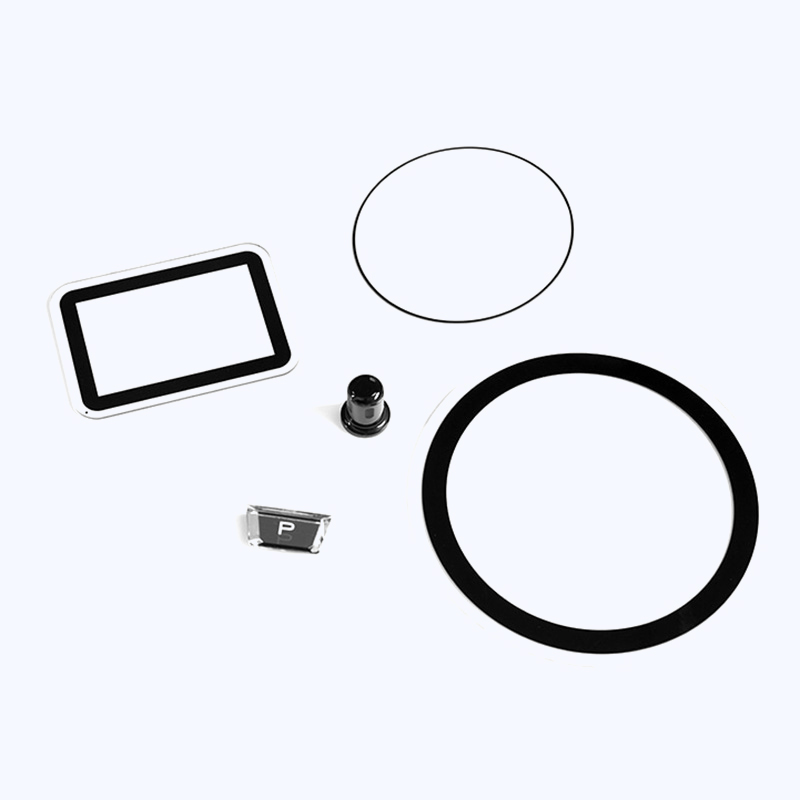
Automotive interiors are being transformed by intelligent displays, integrated sensor systems, advanced lighting, driver monitoring, head-up display technology, and premium decorative surfaces. Within this transformation, automotive interior glass structural components have become much more than simple transparent covers. They are now precision-engineered parts that must combine optical clarity, dimensional stability, mechanical reliability, coating performance, decorative quality, and long-term durability under demanding vehicle conditions.
Automotive interior glass structural components are used in cabin display systems, instrument panels, center control modules, smart mirrors, ambient lighting windows, sensor protection windows, touch-control panels, optical modules, and decorative glass assemblies. These components often serve both functional and aesthetic purposes. They protect sensitive electronics, transmit or reflect light accurately, support human-machine interface functions, and contribute to the visual identity of the cabin. In premium and intelligent vehicles, the quality of these glass structures can directly influence the user experience.
Changzhou Haolilai Photo-Electricity Scientific and Technical Co., Ltd. specializes in precision optical components and applies its optical manufacturing experience to automotive interior glass structural components. Founded in 1998 and located in Changzhou, Jiangsu, China, the company has developed capabilities across laser optics, automotive optics, semiconductor optics, and consumer optics. With ISO9001:2015, ISO14001:2015, and IATF16949 certifications, as well as technical platforms such as the Jiangsu Precision Optical Lens Engineering Technology Center and Jiangsu Enterprise Technology Research Center, the company is positioned to support customers that require reliable, repeatable, and customized automotive glass solutions.
The value of these components lies in the combination of precise glass processing, stable quality control, optical expertise, and automotive-grade production discipline. Compared with general glass fabricators, a precision optical component manufacturer can offer stronger control of surface quality, flatness, thickness tolerance, edge integrity, coating uniformity, and optical consistency. Compared with suppliers that focus only on decorative glass, a company with optical engineering experience can better satisfy applications where clarity, transmission, reflection, imaging quality, and sensor compatibility are critical.
Automotive Interior Glass Structural Components
The Role of Glass Structural Components in Modern Vehicle Interiors
The vehicle cabin has become a digital environment. Traditional mechanical switches and analog instrument clusters are increasingly replaced by integrated screens, optical interfaces, smart control panels, and intelligent sensing systems. As the visible and functional interface between passengers and electronics, glass must perform reliably while maintaining a refined appearance. Automotive interior glass structural components are therefore essential to both design and engineering.
One common application is display protection. Large center information displays, digital instrument clusters, rear-seat entertainment screens, climate-control panels, and touch displays require protective cover glass with high transparency, controlled reflectivity, and resistance to abrasion. The glass surface must preserve display brightness and color accuracy while reducing visual distortion. It must also tolerate repeated touch interaction, cleaning, vibration, and temperature change.
Another important application is optical interface protection. Interior sensor systems, driver monitoring cameras, infrared modules, gesture recognition sensors, and ambient light sensors may require transparent windows or cover parts that allow specific wavelengths to pass with minimum loss. The glass must not introduce unacceptable optical errors, haze, scattering, or ghost reflections. For systems using infrared or near-infrared light, material selection and coating design become especially important.
Smart mirrors and optical modules also depend on glass components. Interior rearview mirrors, camera display mirrors, and optical assemblies may require glass substrates with stable flatness, reflective coatings, anti-glare performance, and precise geometry. In these applications, even minor surface defects or dimensional deviations can affect image quality or assembly accuracy.
Decorative and structural integration is another major trend. Vehicle designers are integrating black panels, seamless displays, illuminated logos, capacitive touch areas, and glass-covered control zones into the dashboard and console. These applications require glass that not only looks premium but also withstands mechanical stress, environmental exposure, adhesive bonding, and long-term use. The component must match the design language of the cabin while remaining manufacturable at scale.
Because these parts are installed inside vehicles, they must satisfy automotive expectations for durability. They may face high and low temperatures, thermal cycling, humidity, ultraviolet exposure, cleaning chemicals, vibration, shock, and repeated handling. Glass is inherently stable and aesthetically attractive, but it must be processed correctly to avoid weak edges, surface flaws, coating failures, or dimensional instability. This is why precision manufacturing and rigorous inspection are crucial.
Core Advantages of Precision Automotive Interior Glass Components
The advantages of high-quality automotive interior glass structural components can be understood from several perspectives: optical performance, mechanical reliability, design flexibility, coating functionality, cleanliness, and automotive-grade consistency. When these advantages are achieved together, the component becomes a reliable part of a complex vehicle system rather than a simple piece of glass.
Optical performance is one of the most important differentiators. A precisely manufactured glass component can provide high transparency, low haze, stable color neutrality, and controlled reflection. For display applications, this helps maintain image clarity and user comfort. For sensor windows, it supports accurate detection and stable signal transmission. For mirror and optical module applications, it helps preserve image quality and alignment.
Mechanical reliability is equally important. The component must resist cracking, chipping, deformation, and failure during assembly and service. Edge quality is especially critical because glass often fails from edge defects. Precision cutting, grinding, polishing, and inspection reduce the likelihood of hidden damage. Proper process control also supports better dimensional repeatability, making the part easier to assemble with frames, adhesives, electronics, and plastic structures.
Design flexibility allows customers to adapt the glass component to different vehicle platforms and interior styles. Shapes may include rectangles, rounded rectangles, irregular contours, holes, slots, notches, curved edges, or customized bonding zones. Surface finishes may include polished edges, chamfered edges, decorative printing, anti-reflective coatings, anti-fingerprint treatments, or other functional layers. A manufacturer with both optical processing and customization capability can support early design collaboration and later mass production.
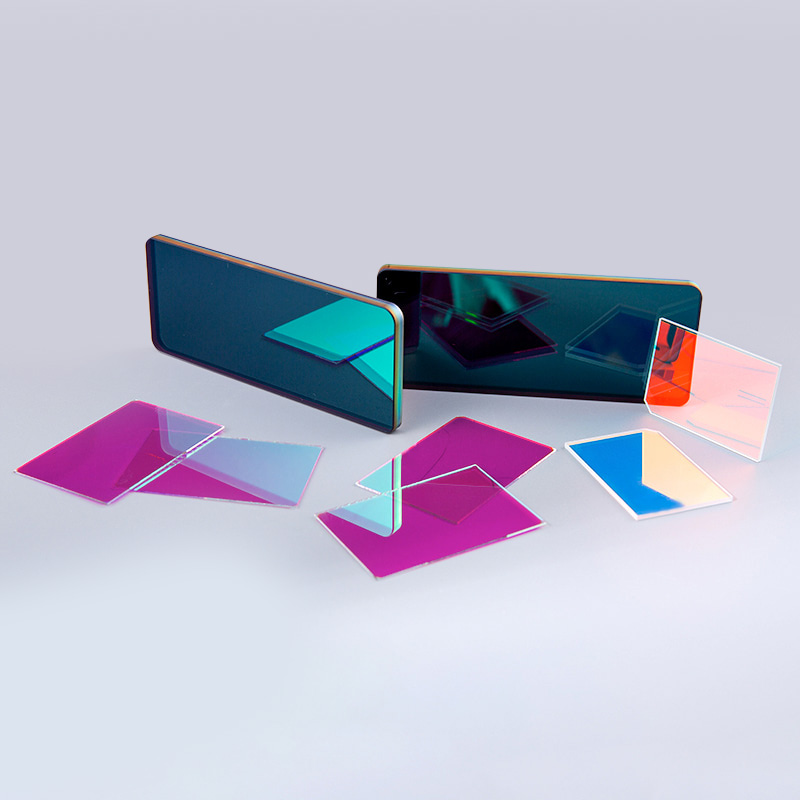
Coating functionality provides additional value. Automotive interior glass may require anti-reflective coating to improve display readability, hydrophobic or oleophobic coating to reduce fingerprints, filter coating to manage wavelength transmission, reflective coating for mirror applications, or protective coating to improve durability. Coating uniformity, adhesion, environmental stability, and compatibility with glass processing are essential. Poor coating control can lead to color inconsistency, peeling, haze, or optical defects.
Cleanliness and surface quality are also critical. Modern displays and optical modules are sensitive to particles, scratches, stains, and surface contamination. A glass component installed over a screen or sensor must not introduce visible defects. Surface inspection and controlled handling help ensure consistent appearance. This is especially important for interior parts because users view them at close distance under different lighting conditions.
Automotive-grade consistency may be the biggest advantage over ordinary glass suppliers. The automotive industry demands stable documentation, traceability, process control, change management, and defect prevention. IATF16949 certification indicates that a supplier has implemented quality systems aligned with automotive expectations. For customers developing vehicle interior modules, this reduces supplier risk and supports long-term production planning.
Why Optical Manufacturing Experience Matters
Automotive interior glass structural components may appear simple from the outside, but many of them require optical-level discipline. A cover glass for a display must not distort images. A sensor window must not reduce detection accuracy. A mirror substrate must support stable reflection. A decorative black panel must preserve premium appearance under strong sunlight. These requirements are closely related to optical manufacturing knowledge.
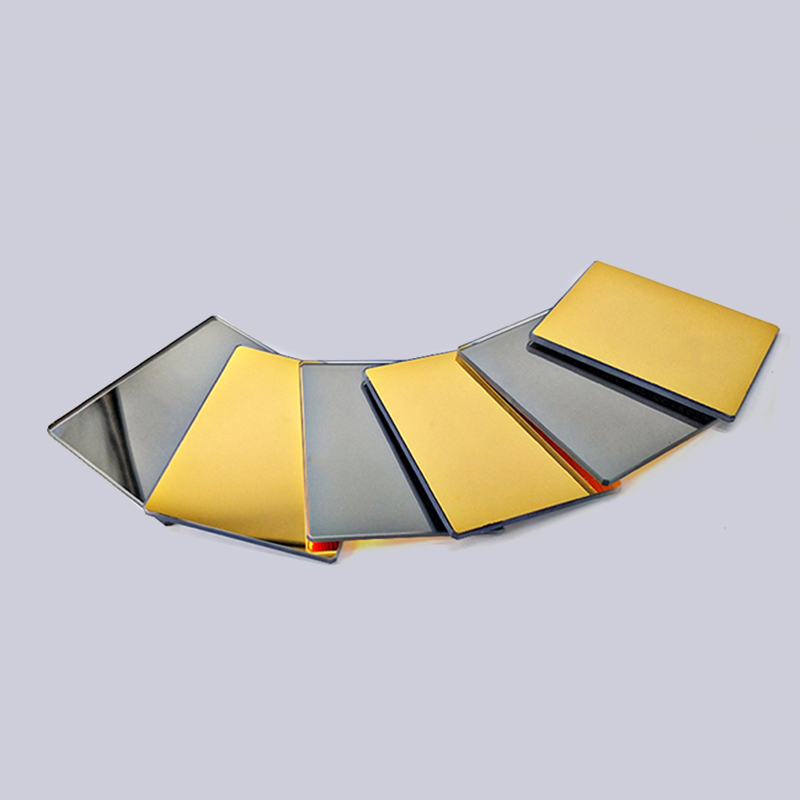
Changzhou Haolilai Photo-Electricity Scientific and Technical Co., Ltd. has long experience in precision optical components such as optical flat mirrors, wafers, optical prisms, optical spherical mirrors, optical lenses, and other optical components. This background is valuable because optical production emphasizes surface precision, defect control, material understanding, process stability, and inspection. These same disciplines can be applied to automotive interior glass structural components.
Compared with competitors that focus mainly on basic cutting and shaping, an optical component manufacturer can provide more comprehensive control over surface flatness, transmitted wavefront quality, coating uniformity, and visual defects. While not every automotive interior part requires the same tolerance as a laboratory optic, optical manufacturing experience helps create a higher reliability margin. This is particularly beneficial for advanced vehicles that integrate displays, sensors, and optical modules into interior surfaces.
Optical manufacturing also strengthens communication with engineering teams. Automotive customers may need to discuss refractive index, transmission curves, reflectance, coating stack design, angular optical performance, polarization effects, surface roughness, or thermal expansion. A supplier familiar with optical terminology and measurement can respond more effectively than a general decorative glass supplier. This reduces design uncertainty and helps prevent late-stage engineering changes.
Another benefit is process integration. Many automotive interior glass components require several steps: raw material selection, cutting, edging, polishing, cleaning, coating, printing, inspection, packaging, and documentation. A company with broad optical processing capability can coordinate these steps to maintain quality from start to finish. If one process is optimized without considering the next, defects may appear later. Integrated optical manufacturing reduces this risk.
Manufacturing Process for Automotive Interior Glass Structural Components
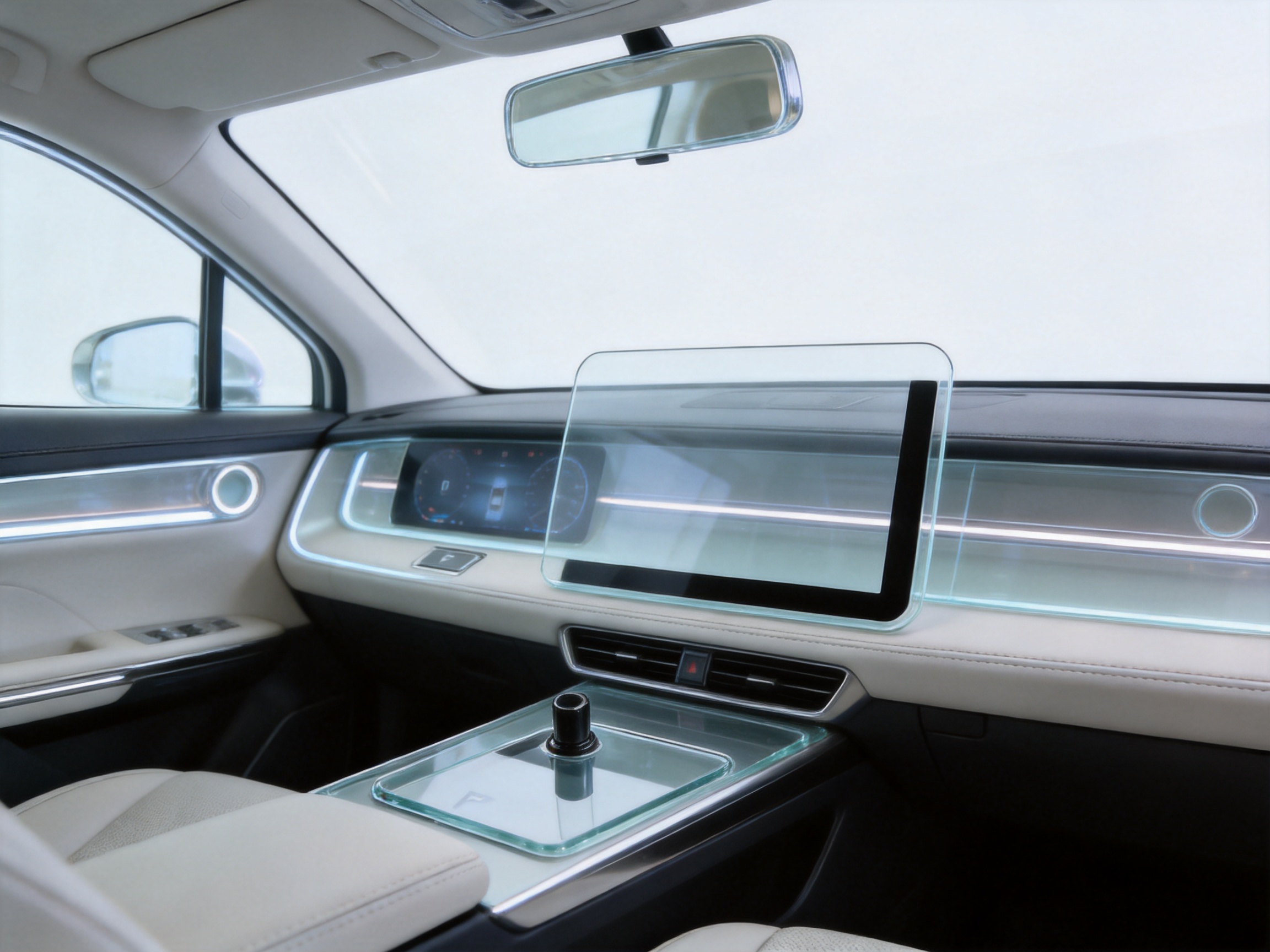
The manufacturing process begins with understanding the customer’s application. A component used for a touch display differs from a sensor window, mirror element, decorative panel, or optical module cover. Engineers must evaluate the required dimensions, thickness, shape, surface requirements, optical properties, coating needs, mechanical constraints, bonding conditions, and environmental tests. Early technical communication helps define a realistic and efficient production route.
Material selection is the next critical step. Different glass types may be selected depending on strength, transparency, thermal behavior, chemical stability, and optical performance. For display cover components, high transparency and low visible defects are important. For sensor windows, wavelength-specific transmission may be required. For mirror and optical applications, substrate flatness and coating compatibility are important. Material consistency is essential for stable mass production.
Cutting and forming define the basic geometry. Precision cutting equipment is used to achieve the required outer contour, holes, slots, or irregular shapes. Because automotive interior designs often include curved corners and seamless integration, the component shape must match the assembly precisely. Cutting parameters must be controlled to minimize microcracks and edge damage.
Edge processing improves mechanical reliability and appearance. Edges may be ground, chamfered, polished, or shaped according to the drawing. Smooth and controlled edges reduce stress concentration and improve handling safety. In visible applications, edge appearance may also influence perceived quality. In bonding applications, consistent edge geometry helps maintain assembly alignment.
Surface polishing and refinement may be required when optical clarity or flatness is critical. Polishing removes processing marks and improves surface quality. For components used in display or imaging systems, surface defects must be carefully controlled. A well-polished surface supports better coating adhesion and more stable optical performance.
Cleaning is not simply a final washing step; it is a quality-critical process. Particles, oils, residues, and stains can cause coating defects, printing failures, bonding issues, or visible blemishes. Controlled cleaning before coating or inspection helps ensure that the glass surface is ready for the next process. Clean handling procedures are important throughout production.
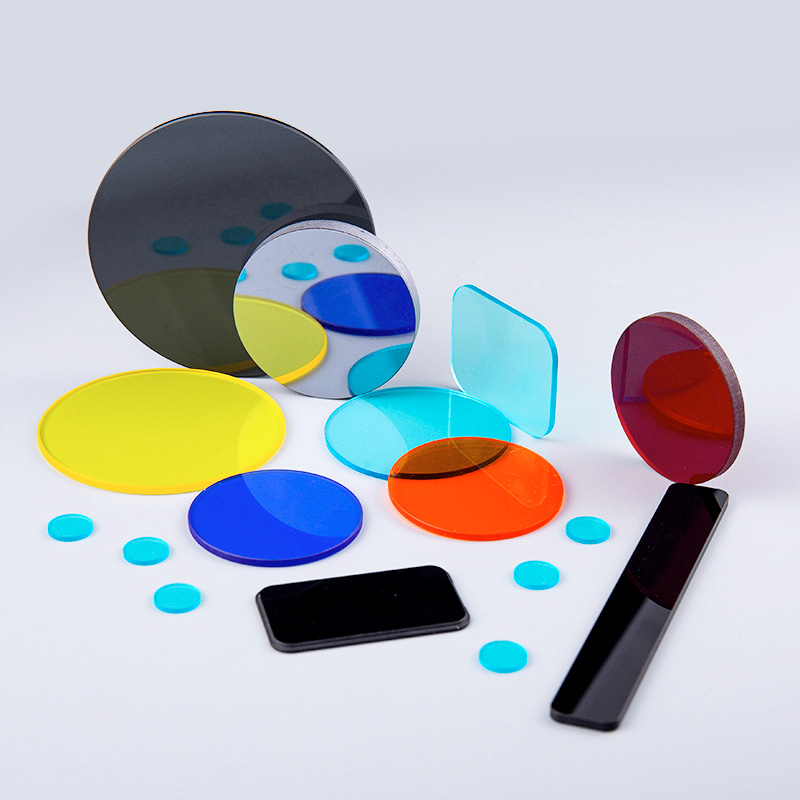
Coating processes add functional performance. Depending on the application, coatings may be designed for anti-reflection, reflection, filtering, protection, hydrophobicity, oleophobicity, or other properties. Coating parameters must be controlled for thickness, uniformity, adhesion, color, and durability. In automotive interiors, coatings must withstand temperature and humidity changes, cleaning, and long-term exposure.
Decorative printing or masking may be added for black borders, icons, touch-control zones, logos, light-transmitting patterns, or hidden sensor areas. The printing must align accurately with the glass geometry and electronic module. Ink adhesion, color consistency, opacity, and environmental resistance are important. For illuminated or display-integrated panels, printing quality has a direct effect on final appearance.
Inspection and testing verify that the component meets requirements. Dimensional inspection confirms shape, thickness, holes, and edge features. Visual inspection checks scratches, chips, stains, inclusions, and coating defects. Optical inspection may evaluate transmission, reflection, haze, flatness, or other parameters. Mechanical and environmental testing may be conducted according to customer requirements.
Packaging protects finished components during transport and storage. Automotive glass components are often sensitive to scratches and contamination, so protective packaging must prevent part-to-part contact, moisture damage, and particle contamination. Traceability labels and documentation support customer quality management.
Manufacturing Strengths of Changzhou Haolilai Photo-Electricity Scientific and Technical Co., Ltd.
Changzhou Haolilai Photo-Electricity Scientific and Technical Co., Ltd. was founded in 1998 and has accumulated decades of experience in precision optical manufacturing. This long production history supports process maturity and engineering understanding. The company is located in the national-level High-tech Development District of Changzhou, Jiangsu, China, and covers an area of 35,000 square meters. The scale of the facility supports stable production, process organization, and capacity for different optical component categories.
The company has more than 300 employees and exports to over 20 countries. This international experience is valuable for automotive interior glass structural components because global customers often require consistent communication, technical documentation, packaging standards, and quality expectations. Export experience also indicates familiarity with diversified customer requirements and application environments.
Certifications are a major strength. ISO9001:2015 demonstrates a quality management framework. ISO14001:2015 reflects environmental management. IATF16949 is particularly important for automotive customers because it focuses on defect prevention, variation reduction, traceability, and continual improvement in automotive supply chains. For a vehicle interior module manufacturer, sourcing from an IATF16949-certified supplier can simplify supplier evaluation and reduce quality risk.
The company has established the Jiangsu Precision Optical Lens Engineering Technology Center and Jiangsu Enterprise Technology Research Center. These technical platforms support product development, process optimization, and engineering problem solving. Automotive interior components often require customization, so research and technical capability are important. Instead of only producing standard parts, the company can participate in design improvement and manufacturing feasibility assessment.
Patents and high-tech product recognition further demonstrate the company’s technical foundation. With multiple invention patents, utility model patents, and Jiangsu high and new technology products, the company shows continuous involvement in innovation. In practical terms, this supports customers that need advanced processing methods, stable optical performance, or customized structural solutions.
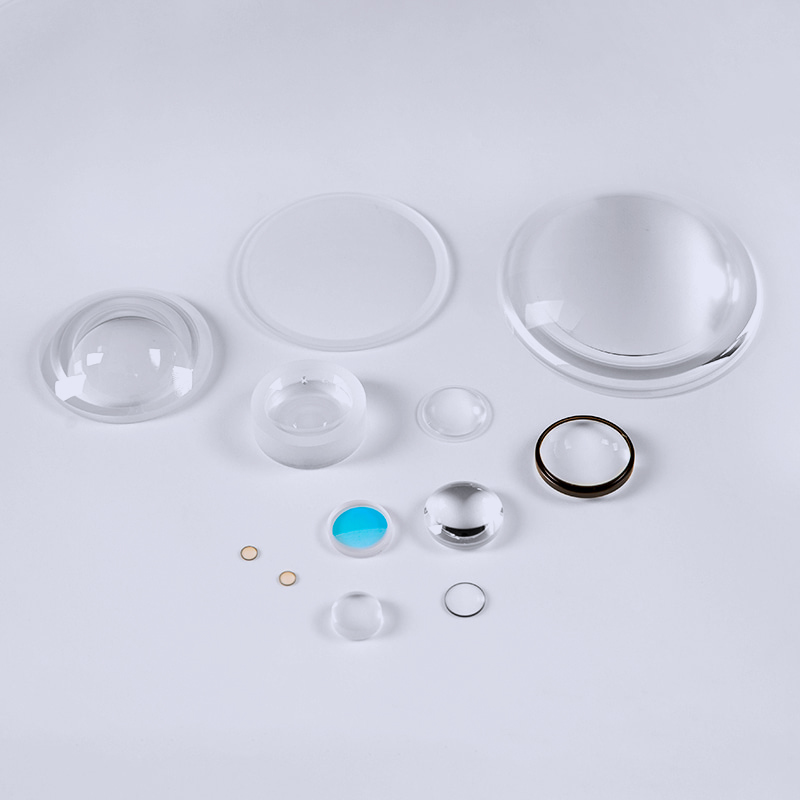
The company’s product range includes optical flat mirrors, wafers, automotive interior glass structural components, optical prisms, optical spherical mirrors, optical lenses, and other precision optical components. This broad portfolio means the company is familiar with different glass shapes, optical surfaces, coatings, and inspection requirements. For automotive customers, this can translate into stronger support for complex assemblies that combine display, sensor, mirror, and decorative functions.
Competitive Advantages Compared with General Suppliers
The market includes many suppliers that can cut glass, polish edges, or apply decorative printing. However, automotive interior glass structural components require a more complete set of capabilities. The difference between a general supplier and a precision optical manufacturer becomes clear when considering tolerance, quality stability, optical performance, coating control, and automotive compliance.
First, optical-grade process control improves performance. General suppliers may focus on appearance and basic dimensions, while precision optical manufacturing also focuses on surface condition, flatness, optical clarity, and defect behavior. This is essential when glass is used over displays, sensors, or imaging systems. Even a small surface issue may be visible to the user or may interfere with optical signal transmission.
Second, automotive quality systems reduce risk. A supplier with IATF16949 certification is better aligned with automotive expectations for production control, corrective action, preventive action, traceability, and continuous improvement. For long-term vehicle programs, this matters. Automotive projects may run for years, and stable quality must be maintained across batches.
Third, customization capability supports modern cabin design. Vehicle interior designs are becoming more individualized and integrated. Customers may need irregular shapes, special edges, coated areas, hidden windows, curved corners, multi-step printing, or parts compatible with adhesive assembly. A supplier with technical and manufacturing flexibility can respond to these needs more effectively than a supplier limited to standard glass panels.
Fourth, coating knowledge provides functional differentiation. Coating is often where glass becomes an engineered component. Anti-reflection coatings improve readability. Reflective coatings support mirror modules. Filter coatings enable sensor functions. Anti-fingerprint coatings improve user experience. Competitors without strong coating and optical understanding may struggle with color uniformity, adhesion, durability, or optical performance.
Fifth, integrated inspection improves final reliability. Automotive glass defects are not always obvious during early production. Edge microcracks, coating pinholes, particle contamination, and small dimensional shifts can cause problems in assembly or service. Precision inspection methods and process records help detect issues before shipment. This reduces customer rework and warranty risk.
| Evaluation Area | Precision Automotive Interior Glass Component | Typical Basic Glass Part |
|---|---|---|
| Optical Performance | Controlled clarity, low visual defects, application-specific transmission or reflection | Usually focused on basic transparency and appearance |
| Dimensional Control | Designed for accurate assembly with displays, sensors, frames, and modules | May be suitable only for less demanding fits |
| Edge Reliability | Processed to reduce chips, microcracks, and stress concentration | Edge quality may vary by batch or supplier |
| Coating Capability | Supports anti-reflective, reflective, protective, filter, and anti-fingerprint functions | Often limited to simple decorative or protective treatments |
| Quality System | Supported by automotive-grade management such as IATF16949 | May lack automotive-specific documentation and control |
| Customization | Adaptable to complex cabin designs and optical requirements | Often focused on standard shapes and simpler requirements |
Application Scenarios in the Intelligent Cabin
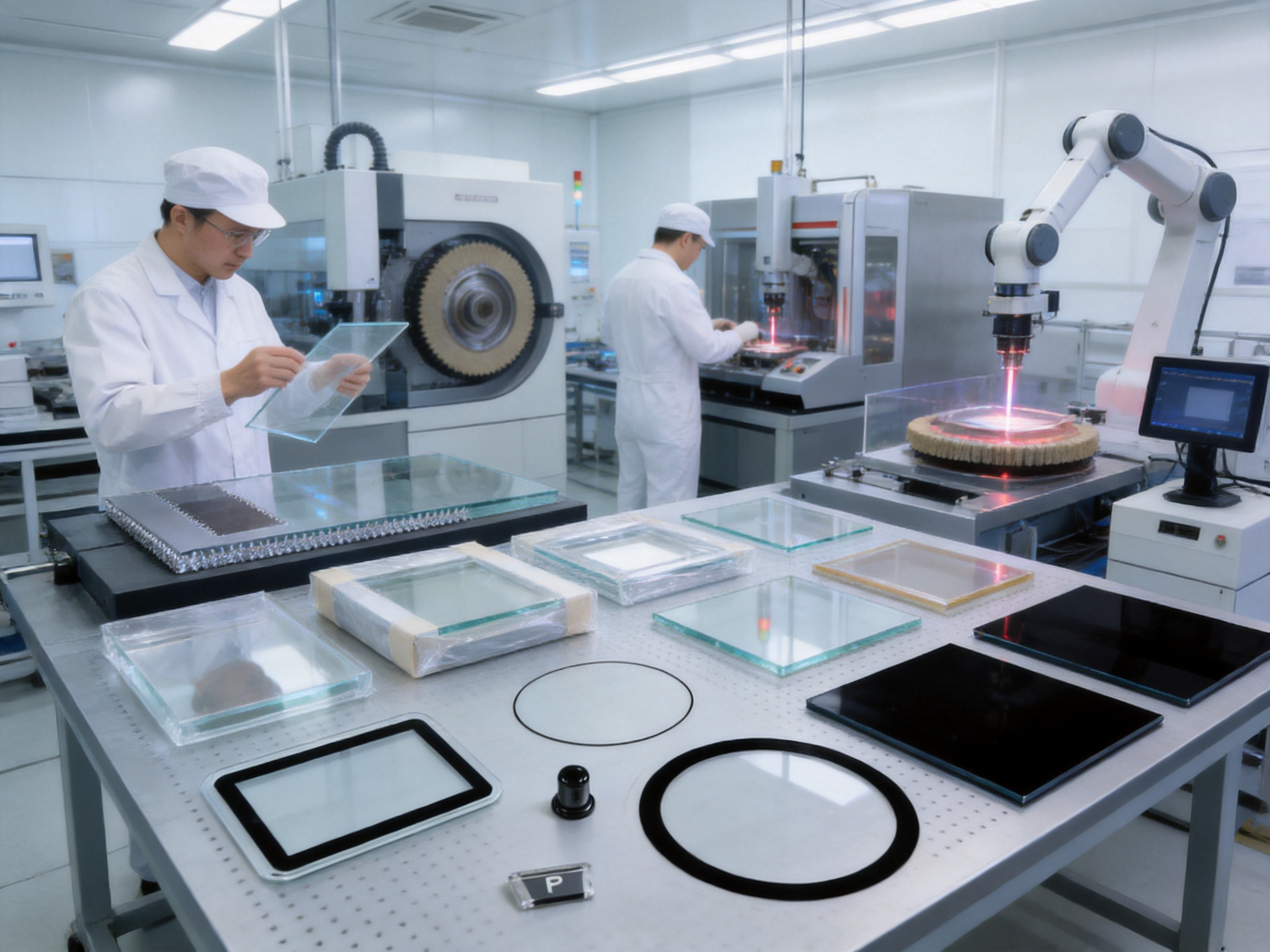
One major application is digital instrument clusters. These displays are directly in the driver’s field of view, so clarity and reliability are essential. The cover glass must preserve the sharpness of speed, navigation, warning, and assistance information. Anti-reflective treatment can help reduce glare from sunlight or interior lighting. Accurate shape and mounting reliability help ensure that the instrument module remains stable throughout the vehicle’s life.
Center information displays are another important use. These screens often serve navigation, entertainment, climate control, communication, and vehicle settings. Users touch the surface frequently, so the glass must resist scratches, fingerprints, and cleaning chemicals. If the surface is uneven, reflective, or easily contaminated, user satisfaction declines. High-quality glass improves both usability and perceived value.
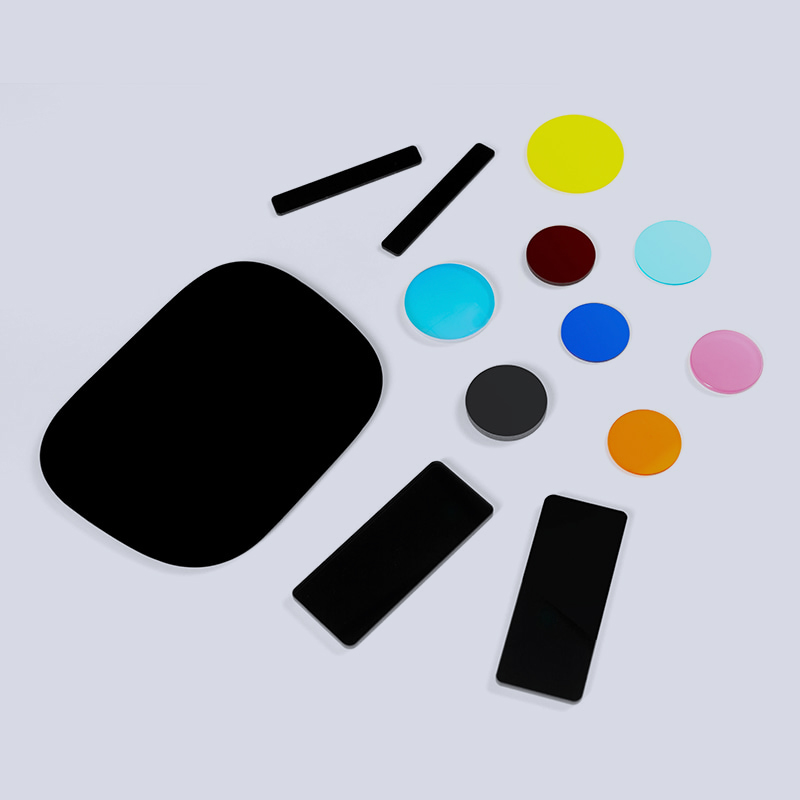
Touch-control panels and black-panel interfaces require excellent cosmetic control. In many modern interiors, physical buttons are replaced by illuminated icons hidden under glass. When the system is off, the panel should appear smooth and uniform. When illuminated, the icons should be clear and consistent. This requires accurate printing, controlled light transmission, clean surfaces, and stable alignment.
Driver monitoring systems may use camera or infrared sensor windows mounted behind the dashboard, steering column, or mirror area. These glass components must protect the sensor while allowing light transmission at the required wavelength. Poor material or coating choices can reduce system accuracy. A precision optical supplier can help select suitable glass and coatings for visible or infrared requirements.
Interior rearview mirrors and camera display mirrors need stable reflective or partially reflective glass structures. The glass substrate and coating must maintain image quality under temperature changes and vibration. For smart mirrors that combine display and reflection, optical balance is important. The component may need to manage brightness, reflectance, transmission, and color neutrality.
Ambient lighting and decorative glass applications are increasing as automakers seek emotional and brand-differentiated interiors. Glass windows, light guides, and decorative panels can create clean, premium lighting effects. These parts require controlled transparency, printed masking, edge processing, and appearance consistency. Poor quality glass may cause uneven light, visible defects, or assembly mismatch.
Optical modules inside the cabin may include head-up display elements, projection windows, lidar-related interior components, gesture sensors, and communication modules. Although not all these applications use the same type of glass, they share a need for optical stability and precise manufacturing. A company with experience in prisms, mirrors, lenses, and flat optical components is well suited to support such applications.
Design Considerations for Automotive Interior Glass Structural Components
Designing a successful glass component begins with the end application. Engineers should define whether the component primarily protects a display, transmits light, reflects images, carries touch input, provides decoration, or supports a structural assembly. Each purpose creates different priorities. A display cover may prioritize anti-reflection and touch durability. A sensor window may prioritize transmission at specific wavelengths. A decorative panel may prioritize color uniformity and surface appearance.
Thickness selection affects strength, weight, optical behavior, and assembly design. Thicker glass may provide more rigidity but increases weight and may create packaging challenges. Thinner glass may support lighter modules but may require stronger edge control and careful handling. The final choice must balance mechanical needs, optical performance, and manufacturing feasibility.
Shape and tolerance design should consider the entire assembly. Glass parts often fit into plastic housings, metal brackets, adhesive frames, display modules, or electronic assemblies. If tolerances are too loose, gaps or stress may occur. If tolerances are unrealistically tight, cost and yield may suffer. Early collaboration between the customer and supplier helps define tolerances that are functional and manufacturable.
Edge design is particularly important. Sharp corners and rough edges increase failure risk. Rounded corners, chamfers, and polished edges can improve reliability. For visible edges, appearance requirements should also be defined. For bonded edges, the design should support adhesive flow and alignment.
Coating design should be linked to the optical system. Anti-reflective coatings must match viewing angles and wavelength ranges. Reflective coatings must meet brightness and color needs. Filter coatings must match sensor requirements. Anti-fingerprint coatings must remain compatible with touch performance and cleaning. Coating decisions should not be treated as a late cosmetic step; they are part of the engineering design.
Printing design must consider opacity, color, thermal resistance, alignment, and light leakage. Black borders can hide adhesive and electronics, but they must be uniform. Icons must be sharp and durable. Light-transmitting patterns must be consistent across the part. Printing and coating interactions should be evaluated because process sequence can affect adhesion and appearance.
Testing requirements should be defined early. Automotive interior parts may need temperature cycling, high-temperature storage, low-temperature storage, humidity exposure, chemical resistance, abrasion testing, coating adhesion testing, vibration testing, and optical measurement. By defining tests early, the supplier can select suitable processes and avoid late failures.
Quality Control and Reliability Assurance
Quality control for automotive interior glass structural components involves more than final inspection. It requires control from incoming material to finished packaging. Raw glass must be checked for material consistency and defects. Processing parameters must be monitored. Operators must follow standardized procedures. Measurement equipment must be calibrated. Nonconforming parts must be isolated and analyzed.
Dimensional inspection verifies the geometry of the part. Measurements may include length, width, thickness, hole position, edge shape, radius, flatness, and other drawing features. Accurate dimensions are necessary for assembly with vehicle modules. If glass dimensions drift, assembly stress, visual gaps, or functional failures may occur.
Visual inspection is crucial because the part is often located in visible cabin areas. Scratches, chips, stains, bubbles, inclusions, coating marks, printing defects, and contamination can affect appearance. Inspection conditions should be controlled because defects may appear differently under different lighting. Automotive customers often require clear defect criteria to ensure consistent judgment.
Optical testing confirms that the component performs as intended. For display covers, measurements may include transmittance, reflectance, haze, and color. For sensor windows, wavelength-specific transmission may be important. For mirror components, reflectance and surface quality matter. For optical module covers, flatness and distortion may be evaluated.
Environmental testing evaluates durability. Interior parts may experience heat when the vehicle is parked in the sun, cold during winter, humidity, rapid temperature changes, cleaning agents, sweat, oils, dust, and ultraviolet exposure. Coatings, inks, adhesives, and glass edges must remain stable. A strong supplier understands how process choices influence test results.
Traceability helps resolve problems quickly. Batch records, process documentation, inspection reports, and material records enable root-cause analysis if an issue occurs. Traceability is also important for automotive program management because customers need confidence that production changes are controlled.
Continuous improvement is essential. Even a stable process can be improved for yield, cost, defect prevention, or performance. A company with research centers, experienced engineers, and automotive quality systems is better able to analyze data and optimize production. This creates long-term value for customers beyond the first order.
How Advanced Manufacturing Supports Customer Value
Advanced manufacturing creates value by reducing uncertainty. When a customer develops a new intelligent cabin module, many factors must work together: the display, sensor, electronics, housing, adhesive, user interface, lighting, software, and glass surface. If the glass component is unstable, the entire module may fail to meet expectations. A reliable manufacturing partner helps stabilize this critical interface.
One value is faster development. Experienced engineers can review drawings, identify manufacturing risks, recommend edge designs, suggest coating options, and help refine tolerances. This can shorten the sample development cycle and reduce costly redesigns. Early collaboration is especially important for new vehicle models with tight launch schedules.
Another value is better assembly efficiency. Glass components with consistent dimensions and clean surfaces are easier to install. Good edge quality reduces handling damage. Proper packaging reduces scratches and contamination. Stable coatings and printing reduce rework. These advantages help customers improve module assembly yield.
Long-term reliability is also a major value. Vehicle interiors must last for years. A component that looks good at delivery but fails after thermal cycling or cleaning is not acceptable. Automotive-grade glass manufacturing focuses on preventing hidden defects and ensuring durability. This protects the customer’s reputation and reduces after-sales risk.
Cost value is not only the lowest unit price. A cheaper component may create hidden costs through higher defect rates, rework, warranty claims, inconsistent appearance, or delayed launch. A precision manufacturer may offer better total value by improving stability and reducing risk. For automotive programs, predictable quality is often more important than a small price difference.
Customization value is increasingly important. Automakers want distinctive interiors, and module suppliers need glass parts that match unique designs. A capable supplier can adjust shape, coating, printing, and optical requirements to support different platforms. This flexibility allows customers to develop differentiated products without sacrificing manufacturability.

Sustainability and Responsible Production
Environmental responsibility is becoming more important in automotive supply chains. ISO14001:2015 certification indicates that Changzhou Haolilai Photo-Electricity Scientific and Technical Co., Ltd. has implemented an environmental management system. For customers, this supports procurement policies that consider not only product quality but also responsible manufacturing practices.
Precision manufacturing can also contribute to sustainability by improving yield and reducing scrap. Glass processing involves energy, water, materials, coatings, and packaging. When processes are controlled, fewer parts are rejected, and resources are used more efficiently. Good quality control therefore supports both economic and environmental goals.
Durable components also reduce waste over the vehicle life cycle. If glass parts resist scratches, coating failure, and environmental degradation, they are less likely to require replacement. A long-lasting component supports the overall durability of the vehicle interior and contributes to customer satisfaction.
Packaging design can protect parts while minimizing unnecessary material. Because glass components are fragile and cleanliness-sensitive, protection is necessary, but it can be optimized. A supplier experienced in export and precision optics understands the balance between protection, cleanliness, and efficient logistics.
Purchasing Considerations for Automotive Interior Glass Structural Components
When selecting a supplier, customers should evaluate more than price. The supplier should understand automotive quality requirements, optical performance, coating processes, dimensional control, environmental testing, and documentation. The ability to support engineering discussions is also important, especially for advanced interior modules.
Customers should prepare clear technical requirements. These may include drawings, 3D files, material specifications, optical targets, coating requirements, appearance standards, testing conditions, packaging needs, and expected production volumes. The more complete the information, the more accurately the supplier can evaluate feasibility and cost.
Prototype evaluation should include both appearance and function. A sample that looks good visually may still have issues with optical transmission, assembly fit, coating durability, or environmental reliability. Testing under realistic conditions helps identify risks before mass production.
Supplier communication should include change management. Automotive programs require strict control of materials, processes, equipment, and inspection methods. If changes are necessary, they should be reviewed and approved. This prevents unexpected differences between sample parts and production parts.
Production capacity and stability should be reviewed for long-term programs. A supplier with a 35,000-square-meter facility, more than 300 employees, and experience exporting to over 20 countries can support different project scales. However, each project should still be evaluated based on its specific volume, complexity, and delivery requirements.
Customers should also consider the supplier’s broader technology base. A company that produces optical flat mirrors, wafers, prisms, spherical mirrors, lenses, and other components may be better equipped to support future cabin technologies. As vehicles integrate more optical functions, a supplier with broad optical capabilities can become a strategic partner.
Q&A: Automotive Interior Glass Structural Components
What are automotive interior glass structural components?
They are precision glass parts used inside vehicles for displays, touch panels, mirrors, sensor windows, decorative panels, lighting interfaces, and optical modules. They may provide protection, optical transmission, reflection, decoration, structural support, or a combination of these functions.
Why is glass used instead of plastic in many interior applications?
Glass offers excellent transparency, surface hardness, dimensional stability, premium appearance, chemical resistance, and optical consistency. While plastic can be useful in some applications, glass is often preferred where scratch resistance, optical clarity, and high-end appearance are important.
What makes these components different from ordinary glass panels?
Automotive interior glass structural components usually require tighter dimensional control, better edge quality, higher optical performance, functional coatings, controlled appearance, and automotive-grade quality management. They are engineered parts rather than simple cut glass.
Why is IATF16949 certification important?
IATF16949 is a quality management standard for the automotive industry. It emphasizes defect prevention, traceability, process control, risk management, and continuous improvement. For automotive customers, sourcing from an IATF16949-certified supplier can reduce quality and supply-chain risk.
Can these components be customized?
Yes. Customization may include shape, size, thickness, edge treatment, holes, slots, coatings, decorative printing, optical transmission, reflectance, and packaging. Early engineering communication helps ensure that the design is both functional and manufacturable.
What coatings are commonly used?
Common coating options include anti-reflective coatings, reflective coatings, protective coatings, filter coatings, hydrophobic coatings, oleophobic coatings, and anti-fingerprint treatments. The correct coating depends on whether the part is used for a display, sensor, mirror, or decorative function.
How does optical manufacturing experience improve product quality?
Optical manufacturing requires careful control of surface defects, flatness, clarity, coating uniformity, and inspection. These capabilities help produce automotive glass components with better visual quality, more stable optical performance, and improved reliability.
What should customers provide when requesting a quotation?
Customers should provide drawings, material requirements, dimensions, tolerances, coating specifications, printing requirements, optical performance targets, environmental test requirements, application details, estimated volume, and packaging expectations.
How are these components inspected?
Inspection may include dimensional measurement, visual defect inspection, edge quality checks, optical transmission and reflection testing, coating evaluation, flatness measurement, adhesion testing, environmental testing, and packaging verification.
What are the main advantages of working with Changzhou Haolilai Photo-Electricity Scientific and Technical Co., Ltd.?
The company offers long experience in precision optical components, automotive quality certification, research and engineering capability, broad optical product expertise, a large manufacturing facility, export experience, and the ability to support customized automotive interior glass solutions.
Future Outlook for Automotive Interior Glass Components
The demand for automotive interior glass structural components is expected to grow as vehicles become more digital, connected, and intelligent. Larger displays, seamless dashboards, integrated lighting, driver monitoring, smart mirrors, and sensor-based interaction will increase the need for precision glass parts. The boundary between decorative interior trim and optical technology will continue to blur.
Future components may need to support higher display brightness, lower reflection, improved anti-fingerprint performance, hidden sensors, curved shapes, thinner structures, and more complex coating designs. As vehicle cabins become more immersive, glass parts must provide both visual beauty and technical function. This will favor suppliers with optical expertise rather than only basic glass processing capacity.
Automotive interior design also emphasizes user comfort and safety. Reducing glare, maintaining readability, protecting sensors, and preventing sharp breakage risks are all important. High-quality glass manufacturing contributes to these goals by improving surface quality, edge reliability, and optical control.
As electric vehicles and intelligent vehicles expand globally, supply chains will require partners capable of stable quality, customization, and innovation. Changzhou Haolilai Photo-Electricity Scientific and Technical Co., Ltd. is positioned to serve this market through its experience in precision optics, certifications, engineering platforms, and manufacturing capabilities.
Conclusion
Automotive interior glass structural components are essential elements of the modern intelligent cabin. They protect displays, support sensors, enable touch interfaces, improve mirror systems, enhance lighting effects, and contribute to premium interior design. Their performance depends on the successful integration of optical clarity, mechanical reliability, coating functionality, dimensional accuracy, and automotive-grade consistency.
Compared with ordinary glass parts, precision automotive interior glass components provide stronger value through better optical performance, improved edge reliability, tighter process control, functional coatings, customization, and quality assurance. These advantages are especially important for advanced vehicles where displays, sensors, and optical systems are deeply integrated into the cabin.
Changzhou Haolilai Photo-Electricity Scientific and Technical Co., Ltd. brings decades of precision optical manufacturing experience, a strong technical foundation, automotive quality certification, and broad optical product capability to this field. With its established manufacturing base, engineering centers, patents, and international experience, the company can support customers seeking reliable, customized, and high-performance automotive interior glass structural components.
For automotive module manufacturers, interior system suppliers, and vehicle designers, choosing the right glass component partner can improve development efficiency, assembly quality, long-term reliability, and final user experience. As intelligent cabins continue to evolve, precision automotive interior glass structural components will remain a key link between optical technology, electronic systems, and refined vehicle design.
References
International Organization for Standardization. ISO 9001:2015 Quality Management Systems: Requirements.
International Organization for Standardization. ISO 14001:2015 Environmental Management Systems: Requirements with Guidance for Use.
International Automotive Task Force. IATF 16949: Quality Management System Requirements for Automotive Production and Relevant Service Parts Organizations.
Hecht, Eugene. Optics. Pearson Education.
Schott AG. Technical Glasses: Physical and Technical Properties.
Society of Automotive Engineers. Automotive Interior Materials, Components, and Performance Testing Publications.
Heraeus and optical materials industry literature on glass processing, coating durability, and precision optical manufacturing.


 苏公网安备32041102000130号